Collector Car Ownership · Insurance · Auto Vault Orlando
By Vincent Howard
Managing Partner, Auto Vault Orlando · Co-Founder, Chin Motorsports / Chin Track Days
Research reviewed September 10, 2026
Collector-car insurance can look deceptively simple until you ask the question that actually matters: if something happens to the car, what does the policy really pay—and under what conditions?
That question becomes even more important in Florida, where collector owners have to think about hurricane exposure, flood, long periods of storage, high-value repairs, changing market values, specialized transport, occasional track use and the fact that many cars spend far more time parked than driven.
The biggest mistake is assuming that “full coverage,” “collector insurance,” “agreed value,” or “stored indoors” tells you enough.
It does not.
A good collector-car policy should match the car, the way you use it, and the place where it actually lives.
This guide is designed to help Florida owners ask better insurance questions before there is a claim.
Quick answer: What should Florida collector-car owners look for in insurance?
Florida collector-car owners should look beyond premium price and compare the policy’s loss-settlement method, agreed or stated value language, comprehensive coverage, liability limits, uninsured/underinsured motorist options, storage requirements, usage restrictions, driver eligibility, hurricane and flood coverage, transport protection, repair-shop choice, modification coverage, track-day exclusions and the insurer’s requirements for where the vehicle is garaged.
If the car will be kept in professional storage, owners should also understand the difference between their own vehicle policy and the storage facility’s commercial insurance. One does not automatically replace the other.
In this Florida collector-car insurance guide
- Florida’s legal insurance baseline
- Agreed value vs. stated value vs. actual cash value
- What changes when the car is stored
- Windstorm, flood, theft and comprehensive coverage
- Why the garaging address matters
- Your policy vs. a storage facility’s insurance
- Who is insured to move the car?
- Repair shop, OEM parts and specialized repairs
- Modifications, restoration and spare parts
- Keeping the agreed value current
- Hurricane-season insurance questions
- Transport and off-premises coverage
- Track days and HPDE exclusions
- Multi-car collections, UM and umbrella coverage
- 20 questions to ask your insurer or agent
- Collector insurance scorecard
- Frequently asked questions
1. Start with Florida’s legal insurance baseline
Collector-car insurance is still automobile insurance, so Florida’s registration requirements matter.
Current Florida Highway Safety and Motor Vehicles guidance says that before registering a vehicle, an owner generally must show proof of:
- $10,000 Personal Injury Protection (PIP); and
- $10,000 Property Damage Liability (PDL).
FLHSMV also says the required coverage must be maintained continuously throughout the registration period.
That detail becomes very important for stored collector cars.
Can you drop insurance because the car is not being driven?
Not casually if the vehicle remains actively registered.
Florida’s current driver handbook says that if you do not maintain required insurance throughout the registration period, you should surrender the license plate before cancelling coverage to avoid possible suspension and reinstatement consequences.
The statutory minimum is not the same as an appropriate collector-car limit
A legal minimum answers one question:
What is required to maintain registration?
It does not answer:
- how much liability protection fits your assets;
- whether the car itself is properly insured;
- whether a $250,000 collector vehicle is valued correctly;
- or how an uninsured-driver claim would affect you.
Florida’s Department of Financial Services specifically warns consumers that terms such as “full coverage” and “what’s required” can be misleading because people use them to mean different things.
2. Agreed value vs. stated value vs. actual cash value
This is the section I would understand before comparing premiums.
Two policies can both insure the same Porsche 911, Ferrari, Corvette, Mercedes-Benz, Jaguar or vintage pickup and produce very different total-loss outcomes because the valuation method is different.
| Valuation Method | How It Generally Works | Main Question for the Owner |
|---|---|---|
| Actual Cash Value (ACV) | Value is determined at the time of loss using market/value evidence and policy rules. | How will the insurer establish what my exact car was worth immediately before the loss? |
| Stated Value / Stated Amount | A value is listed on the policy, but the settlement provision may allow payment of a lower amount depending on policy wording. | Is the stated amount the guaranteed settlement or only the maximum limit? |
| Agreed Value | You and the insurer agree to a vehicle value in advance, subject to the exact loss-settlement provision. | Does the policy state that the agreed amount is paid after a covered total loss, subject only to stated deductible/salvage terms? |
Florida’s Department of Financial Services says collision total-loss payments are typically limited to actual cash value unless a specific vehicle value has been agreed to in advance by the insurer and policyholder.
Specialty insurers explain the distinction more explicitly. Hagerty’s current 2026 insurance guidance describes agreed value as an amount established between the owner and insurer before loss, while its explanation of stated value warns that the amount shown may not necessarily equal the final total-loss settlement.
Why this matters more for collector cars
Standard market databases often work reasonably well for ordinary late-model cars because there are many comparable vehicles.
Collector cars are different.
Value can turn on:
- condition;
- originality;
- mileage;
- provenance;
- restoration quality;
- factory options;
- color;
- transmission;
- numbers-matching status;
- competition history;
- and the very small number of genuinely comparable cars available.
A generic “2015 Porsche 911” database result may tell you almost nothing useful about the value of a rare specification.
The Total-Loss Question
Do not ask only: “Is this agreed value?”
Ask: “Show me the exact policy language that determines what I receive after a covered total loss.”
Then ask about deductibles, taxes/fees, salvage retention, automatic value increases and any circumstances that can reduce the settlement.
3. Storage changes the risk—but does not eliminate it
A collector car sitting in a climate-controlled garage is not exposed to normal commuter mileage, traffic or parking-lot damage.
But the car is still exposed to risk.
Examples include:
- fire;
- theft;
- windstorm;
- flood;
- falling objects;
- water intrusion;
- vandalism;
- accidental handling;
- and transport-related loss.
That is why “I don’t drive it very much” is not the same as “I don’t need insurance.”
Some specialty insurers offer storage-oriented or comprehensive-only options for vehicles that truly remain out of regular use. But Florida’s registration requirements still need to be considered before removing liability/PIP/PDL coverage from a registered vehicle.
For owners who store a vehicle for months at a time, the conversation with the insurer should include:
- whether the vehicle remains registered;
- whether the policy permits reduced-use or storage status;
- how the garaging location is rated;
- what physical-damage coverage remains;
- who is allowed to move it;
- and what must happen before the car is returned to regular road use.
For the mechanical side of long-term storage, see How to Prepare a Porsche, Ferrari or Lamborghini for Extended Storage.
4. Comprehensive coverage matters enormously in Florida
Florida’s Department of Financial Services describes comprehensive—also called “other than collision”—as coverage that can respond to vehicle damage from events such as:
- fire;
- theft;
- windstorm;
- vandalism;
- flood;
- falling objects;
- and animal strikes.
That list explains why comprehensive coverage matters even when a collector vehicle barely moves.
A car can suffer a catastrophic loss without travelling one foot.
Hurricane-season question
Do not stop at:
“I have comprehensive.”
Ask:
- Is windstorm covered under this policy?
- Is flood covered?
- What deductible applies?
- Is there any hurricane-specific restriction or binding moratorium once a storm is approaching?
- Does the policy require the vehicle to be stored in a particular type of building?
- If I temporarily relocate the car, do I need to tell the insurer?
For the storage side of storm planning, see Hurricane Season Car Storage in Florida.
5. Where the car lives can affect eligibility and underwriting
Collector policies often care about the storage location.
Hagerty’s current eligibility guidance says it prefers collector vehicles to be stored in an enclosed, secure structure when not in use, while still considering certain other arrangements. Grundy’s current collector application similarly asks about garage construction, garaging address and security features.
That means the following details can matter:
- home garage versus commercial storage facility;
- enclosed versus open parking;
- alarm systems;
- controlled access;
- fire protection;
- monitoring;
- and the exact garaging address.
Tell the insurer where the car actually lives
If the policy says the car is garaged at your residence but it spends six months a year in professional storage, that is worth discussing with the carrier.
Likewise, if a snowbird moves the vehicle between Florida and another state seasonally, the carrier should know the real pattern.
Accurate underwriting information protects both sides.
If you are comparing professional storage in Central Florida, start with What to Look for in Exotic Car Storage: 15 Questions to Ask Before You Choose a Facility.
6. Orlando owners may encounter a pre-insurance inspection
This is a very Florida-specific detail.
Florida’s current preinsurance-inspection statute applies to certain private-passenger policies with physical-damage coverage, subject to multiple exemptions and insurer opt-out provisions.
The Florida Department of Financial Services specifically identifies Orange County among the counties where preinsurance physical-damage inspection requirements can apply.
The statute includes important exceptions, including:
- vehicles 10 years old or older;
- renewal policies;
- certain continuously insured policyholders;
- new unused vehicles purchased or leased from licensed dealers;
- and insurers that have formally opted out and established their own inspection requirements.
For modern exotics in the Orlando area, photos or a formal inspection may therefore be part of the underwriting process depending on insurer and facts.
7. Your policy and the storage facility’s insurance are two different things
This may be the most important storage-related insurance concept in the article.
A professional storage facility may carry commercial policies designed for businesses that have customer vehicles in their care, custody or control.
Specialty commercial insurance programs may include coverages such as:
- garagekeepers legal liability;
- warehouse legal coverage;
- general liability;
- property coverage;
- transit coverage;
- and business-interruption coverage.
But those policies do not automatically mean the facility “insures your car for everything.”
Garagekeepers coverage can be written on different bases. Some forms respond to the facility’s legal liability; others can be broader. Policy limits, exclusions, deductibles and valuation methods matter.
That is why owners should ask two separate questions:
- What does my own collector-car policy cover while the vehicle is in storage?
- What does the facility’s commercial insurance cover if the facility is legally responsible for damage?
Auto Vault Orlando’s current terms require stored vehicles to be insured by the client, which is consistent with the broader principle that owners should maintain their own vehicle coverage rather than assuming facility insurance replaces it.
8. Who is insured to move the car?
This becomes important the moment a vehicle is stored somewhere other than your own garage.
Someone may need to:
- move the car within the facility;
- stage it for pickup;
- load it onto a transporter;
- move it during maintenance;
- or relocate it in an emergency.
Florida’s Department of Financial Services advises owners to review who is covered to use their vehicles because some policies provide permissive-use coverage while others cover only specifically listed operators or impose other restrictions.
Ask your insurer:
“If an employee of my storage facility moves this vehicle on private property or on a public road, how does my policy respond?”
Then ask the storage facility how its own coverage responds.
Those answers should not be assumed to be identical.
9. Repair-shop choice matters more when repairs require rare expertise
After a claim, an ordinary collision shop may be perfectly capable of repairing an ordinary vehicle.
A collector or exotic car may require:
- aluminum or carbon-fiber repair expertise;
- factory-certified structural procedures;
- obsolete or rare parts;
- special paint processes;
- historic trim restoration;
- marque-specific calibration;
- or a shop capable of preserving originality.
Ask whether the policy allows you to choose the repair facility.
Also ask:
- How are OEM or original-equipment parts handled?
- What if a part is unavailable?
- Will the insurer pay to repair rather than replace a rare component?
- How are betterment and depreciation handled?
- Are specialty labor rates considered?
- Can the car be transported to an out-of-area specialist?
This becomes particularly important with low-production cars for which “comparable replacement part” can be a difficult concept.
10. Modifications, restorations and custom equipment need to be disclosed
Florida’s Department of Financial Services notes that customized equipment added after manufacture may require an endorsement and additional coverage.
For collector vehicles, that can include:
- engine upgrades;
- wheels;
- brakes;
- suspension;
- bodywork;
- audio systems;
- restomod conversions;
- custom interiors;
- paint;
- and major restoration work.
The insurer cannot accurately value a $200,000 restomod if the application describes a stock $70,000 vehicle.
Cars under restoration need a different conversation
A project can change value dramatically as work progresses.
If a car begins as a $40,000 project and becomes a $150,000 completed restoration, the insured value should not remain frozen at the original number.
Ask whether the policy offers:
- restoration-in-progress coverage;
- automatic value increases during restoration;
- coverage for disassembled components;
- coverage for parts stored separately;
- and a process for increasing the agreed value during the build.
11. Agreed value should not become “agreed forever”
A collector policy solves one valuation problem only if the insured value remains realistic.
Markets move.
So do individual cars.
A restoration can improve value. A market boom can increase it. A correction can reduce it. A rare sale can reset expectations for a particular specification.
I would review the insured value at least annually and after major events such as:
- a restoration;
- a significant modification;
- a major market move;
- an important concours award;
- new provenance documentation;
- or a substantial change in condition.
Hagerty and Grundy both publish collector programs that allow insured values to be reviewed or adjusted. The exact automatic-increase features, if any, vary by carrier and policy.
Insurance Value Review Trigger
Editorial framework only. Bars are not actuarial percentages.
12. Florida hurricane coverage requires more than checking one box
Comprehensive coverage is the obvious place to start because Florida DFS includes windstorm and flood among common comprehensive losses.
But hurricane-season preparation should go further.
Ask:
- Is flood covered while the car is stored?
- Is wind-driven water treated differently from flood?
- Is a fallen tree covered?
- What happens if the building roof fails?
- Does moving the vehicle to temporary storage change anything?
- Can I increase physical-damage coverage after a storm has been named?
- Does the insurer impose binding restrictions during an approaching storm?
- What documentation should I keep before hurricane season?
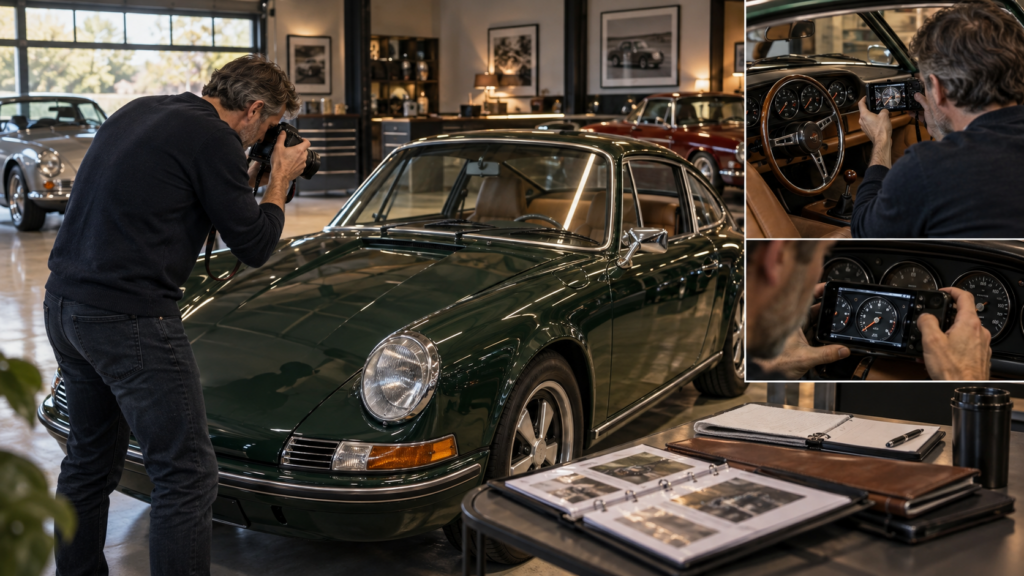
Before storm season, photograph the vehicle and make sure the current insured value still matches reality.
If the vehicle lives at Auto Vault or another professional facility, keep a copy of the storage agreement and current storage location with your insurance records.
13. Transport is a separate insurance event
Collector vehicles move even when owners do not drive them.
They travel by enclosed transporter to:
- service facilities;
- auctions;
- shows;
- concours events;
- track weekends;
- seasonal residences;
- and storage facilities.
Ask who covers the car during:
- loading;
- transit;
- temporary overnight holding;
- and unloading.
The transporter’s cargo policy and your collector policy may both matter.
Never assume the transport company’s advertised “$1 million insurance” means your individual car is automatically covered for its full value under every circumstance.
Ask for the actual certificate or coverage information and compare it with the car’s value.
14. Collector insurance and track-day insurance are not the same thing
This is especially relevant to our community because many Auto Vault members and Chin Track Days participants own street-driven performance cars.
Most ordinary auto policies exclude at least some on-track use, and current specialty-insurance guidance warns that HPDE, racing, speed-contest and racing-surface exclusions are common.
Separate single-event HPDE or track-day physical-damage policies exist for qualifying vehicles and events.
Before a track day, ask:
- Does my collector policy exclude the vehicle once it enters the track property?
- Does the exclusion apply only while driving on track, or also in the paddock?
- Is HPDE treated differently from competitive racing?
- Is liability included in the separate track policy?
- Does the track policy cover an instructor or second driver?
- Are modifications included in the insured value?
Do not learn the answer after Turn 17 at Sebring.
For Florida circuits and HPDE context, see Best Florida Tracks for Enthusiasts.
15. Multi-car collectors should think beyond each vehicle individually
Once the garage contains several meaningful cars, the insurance conversation becomes a collection-management conversation.
You may need to think about:
- combined values;
- catastrophic loss affecting multiple vehicles at one location;
- umbrella liability;
- uninsured/underinsured motorist coverage;
- drivers across several cars;
- newly acquired vehicle provisions;
- vehicles stored at multiple locations;
- transport;
- parts and memorabilia;
- and policy limits that apply per car versus per occurrence.
UM coverage deserves a real conversation in Florida
Florida DFS explains that uninsured/underinsured motorist coverage can pay for bodily injury when the at-fault driver has no bodily-injury coverage or not enough of it.
Florida also has specific rules around stacked and non-stacked UM coverage.
That does not mean one option is automatically right for every collector.
It means high-net-worth owners should not let the exotic car’s physical-damage coverage distract them from protecting the people inside it.
20 questions every Florida collector-car owner should ask
- What exact loss-settlement method applies to my car?
- Is the insured amount truly agreed value, stated value or actual cash value?
- What could reduce the total-loss payment?
- How often should the insured value be reviewed?
- What usage is allowed—pleasure driving, commuting, errands, shows, rallies?
- Are there mileage limits or only usage restrictions?
- What storage conditions are required?
- Do I need to notify you if I move the car to professional storage?
- Who is allowed to drive or move the vehicle?
- How does the policy respond if storage-facility staff move the car?
- Is windstorm covered?
- Is flood covered?
- What deductible applies to comprehensive and collision losses?
- Can I choose the repair shop?
- How are OEM, rare or obsolete parts handled?
- Are modifications and restoration work included in the insured value?
- What coverage applies during enclosed transport?
- What happens if I retain the salvage after a total loss?
- Is HPDE or track use excluded, and where does the exclusion begin?
- What would surprise me most if I had a claim tomorrow?
That final question is worth asking your agent exactly as written.
The Auto Vault Collector Insurance Scorecard
This is an original Auto Vault editorial framework. It is not an insurance recommendation, actuarial model or legal standard.
Give yourself 0–3 points in each category.
| Category | 0 | 1 | 2 | 3 |
|---|---|---|---|---|
| Loss settlement | Unknown | Term recognized | Policy reviewed | Exact settlement understood |
| Insured value | Old/guess | Rough estimate | Market supported | Current and documented |
| Storage disclosure | Unknown | Informal | Carrier knows | Carrier confirms arrangement |
| Comprehensive risks | Unknown | Basic | Flood/wind reviewed | Deductibles/exclusions understood |
| Driver rules | Unknown | Assumed | Named drivers checked | Storage/transport drivers addressed |
| Repair terms | Unknown | Basic shop choice | Specialty repair reviewed | Parts/labor/transport understood |
| Track use | Unknown | Assumed excluded | Policy reviewed | Separate track plan where needed |
| Annual review | Never | Occasional | At renewal | Renewal + major value triggers |
| 20–24 | Well understood. You appear to know what the policy is designed to do. |
| 14–19 | Good foundation. Clarify the categories still based on assumptions. |
| 8–13 | Coverage gaps may be hiding in the details. Review valuation, storage and drivers first. |
| 0–7 | The declarations page is doing too much of the thinking. Schedule a real policy review. |
How storage at Auto Vault Orlando fits into the insurance conversation
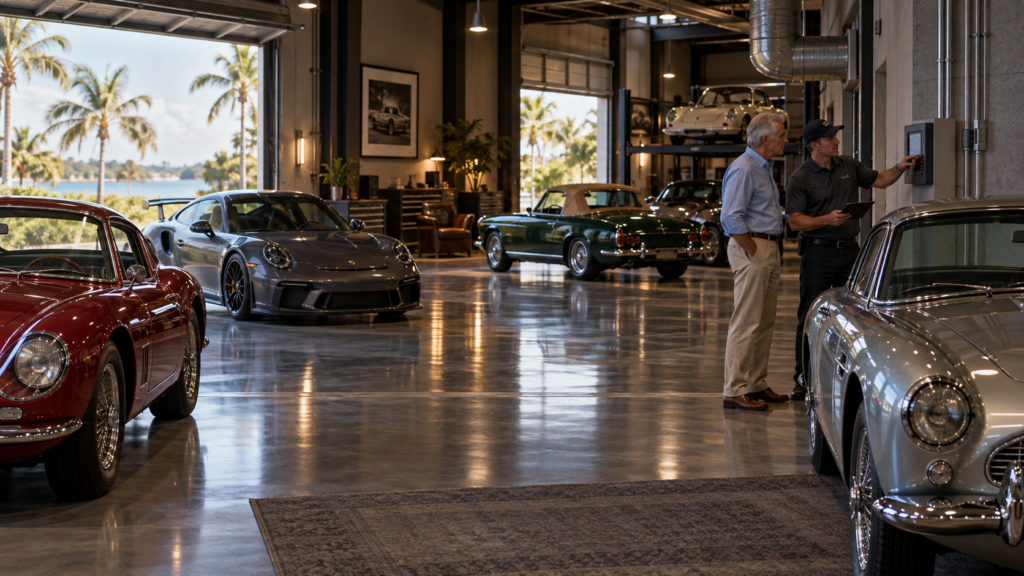
Auto Vault Orlando is a climate-controlled vehicle Vault and private automotive club serving Central Florida. Current published information describes the storage environment as climate controlled year-round, protected by 24/7 monitored security and built around controlled, private access.
The current Auto Vault FAQ also says battery-maintenance support is available, and that storage can accommodate different ownership needs and durations.
But professional storage should never be treated as a substitute for appropriate insurance.
Auto Vault’s current terms require clients to maintain insurance on stored vehicles. Owners should review both their collector-car policy and the current storage agreement so that:
- the carrier knows where the vehicle is stored;
- the insured value is appropriate;
- driver and movement rules are understood;
- and everyone knows who is responsible if a loss occurs.
Storage and insurance are strongest when the two plans agree about where the car is, who can touch it and how it is protected.
Frequently asked questions about collector-car insurance in Florida
Does Florida require insurance on a collector car?
If the vehicle is registered for road use, Florida’s current registration rules generally require at least $10,000 in PIP and $10,000 in property-damage liability coverage, with required coverage maintained continuously during the registration period.
Can I cancel insurance if my collector car is in storage?
Do not cancel required coverage while leaving the Florida registration active without first confirming the consequences. FLHSMV advises owners to surrender the plate before cancelling required insurance if coverage will not be maintained.
What is agreed-value collector-car insurance?
Agreed value generally means the vehicle’s insured value is established between the owner and insurer before a loss. The exact settlement still depends on the policy wording, deductible, salvage provisions and endorsements.
Is agreed value better than actual cash value?
For many collector cars, agreed value can provide greater certainty because the amount is established before the loss rather than relying entirely on a post-loss market valuation. Whether it is “better” depends on the policy, premium and vehicle.
What is stated-value insurance?
Stated-value or stated-amount policies list a value on the policy, but that number may function as a maximum limit rather than a guaranteed total-loss payment. Read the loss-settlement clause rather than relying on the label.
Does comprehensive insurance cover hurricanes in Florida?
Florida DFS describes comprehensive coverage as commonly covering windstorm and flood among other non-collision losses. Actual hurricane, flood and deductible terms depend on the policy.
Does homeowners insurance cover my collector car in the garage?
Do not assume it does. The automobile itself generally remains an auto-insurance exposure even when parked at home or in storage.
Does a professional storage facility insure my collector car?
A facility may carry commercial insurance such as garagekeepers or warehouse legal coverage, but that does not automatically replace the owner’s collector-car policy. Review both policies and the storage contract.
What is garagekeepers insurance?
Garagekeepers coverage is commercial insurance designed to address customer vehicles in a business’s care, custody or control. The basis of coverage can vary, including legal-liability and broader forms, so policy structure and limits matter.
Should I tell my insurer that my car is stored at Auto Vault Orlando?
Yes when required by the policy or underwriting guidelines. The safest approach is to accurately disclose where the vehicle is principally garaged or stored and ask the carrier to confirm the arrangement is acceptable.
Can storage-facility employees drive my car?
That is both a storage-contract and insurance question. Ask who the facility authorizes to move vehicles and ask your insurer how your policy treats that use.
Do collector policies have mileage limits?
Some do; others focus more on the type of use than a fixed mileage number. Restrictions vary substantially among carriers.
Can I commute in a car insured on a collector policy?
Possibly not. Many collector programs are designed for pleasure, club and hobby use rather than regular commuting or daily transportation. Confirm the exact policy restrictions.
Does collector insurance cover modifications?
It can, but modifications should be disclosed and reflected in the insured value or an appropriate endorsement. Florida DFS notes that custom equipment may require additional coverage.
Can I choose the shop that repairs my collector car?
Many specialty policies provide broad repair-shop choice, but verify the exact policy. Also ask how specialty labor rates, OEM parts and unavailable components are handled.
Does collector-car insurance cover track days?
Do not assume it does. Track, HPDE, racing and speed-event exclusions are common. Separate single-event or annual motorsports coverage may be available for qualifying vehicles and events.
Do I need separate track-day insurance for an HPDE?
Often, yes, if your normal auto policy excludes HPDE or track-surface use. Track-day products generally focus on physical damage and may not provide liability coverage, so read both policies.
How often should I update the agreed value?
Review it at least at renewal and after major changes such as restoration, significant modifications, large market movements or newly documented provenance.
Does Florida require an insurance inspection in Orlando?
Florida has a preinsurance-inspection statute for certain physical-damage policies, and Orange County is among the counties where it can apply. However, there are multiple exemptions—including for vehicles 10 years old or older—and insurers can opt out and use their own inspection requirements.
What should I do if I disagree with a claim settlement?
Florida DFS advises consumers to document their position and provide supporting evidence. Certain automobile disputes may also be eligible for state-facilitated mediation. For significant collector-car claims, professional legal or appraisal advice may also be appropriate.
Is diminished value covered after a collector car is repaired?
Florida DFS notes that Florida law is silent on a definitive diminished-value calculation and that first-party physical-damage claims have generally been treated differently from third-party claims. Specialty policy endorsements can vary, so ask whether your policy provides any specific post-repair diminution coverage.
What insurance documents should I keep for a collector car?
Keep the policy, declarations, endorsements, appraisal or valuation support, recent photos, VIN information, modification/restoration documentation, storage agreement and contact information for the insurer, storage facility and preferred repair shop.
How this article was researched
This guide combines my experience in the collector and performance-car community with current Florida regulatory and insurance information.
Research reviewed includes the Florida Driver License Handbook, the Florida Department of Financial Services automobile-insurance overview, Florida Statute 627.744 on preinsurance inspection, current collector-insurance explanations from Hagerty and Grundy, current collector-storage underwriting guidance, track-day insurance guidance and Auto Vault Orlando’s current storage information.
This article is educational and does not provide insurance, legal, tax or financial advice. Coverage varies by insurer, policy form, endorsement, vehicle, driver, location and claim facts. The actual policy contract controls.
Auto Vault Orlando · Central Florida
Your storage plan and your insurance policy should agree about where the car lives.
If you are reviewing collector-car insurance, it is also a good time to review the environment where the vehicle spends most of its life.
Auto Vault Orlando currently provides climate-controlled vehicle storage, 24/7 monitored security, controlled private access and battery-maintenance support for exotic, classic, luxury and collectible vehicles in Central Florida.
Tour the Vault, ask the insurance questions in this guide, and make sure the storage and coverage decisions fit the same ownership plan.