
Collector Car Preservation · Florida Humidity
By Vincent Howard
Managing Partner, Auto Vault Orlando · Co-Founder, Chin Motorsports / Chin Track Days
Research reviewed September 16, 2026
Florida humidity gets blamed for almost everything that happens to a stored collector car: faded paint, moldy leather, electrical problems, rust, cloudy trim, dead batteries and mysterious interior smells.
Some of that blame is deserved.
Some of it is not.
Humidity does not affect every material in a car the same way, and there is no single magic relative-humidity number at which an otherwise healthy vehicle suddenly starts deteriorating.
Paint behaves differently from leather. Leather behaves differently from steel. Electronics are most vulnerable when moisture combines with contaminants, electrical bias or actual condensation. Metal corrosion can accelerate dramatically when humidity rises—but salts and surface contamination can lower the humidity threshold at which corrosion becomes active.
That distinction matters if you own a collector, exotic, classic or high-performance car in Florida.
The real enemy is not “Florida air.” It is persistent moisture in the wrong place, for the wrong amount of time, combined with materials that are vulnerable to it.
This guide explains what actually happens to paint, leather, electronics and metal in humid conditions—and how to evaluate a home garage or professional storage facility without relying on vague phrases such as “air conditioned” or “climate controlled.”
Quick answer: Is Florida humidity bad for collector cars?
Persistent high humidity can increase risk, but humidity does not damage every vehicle component in the same way.
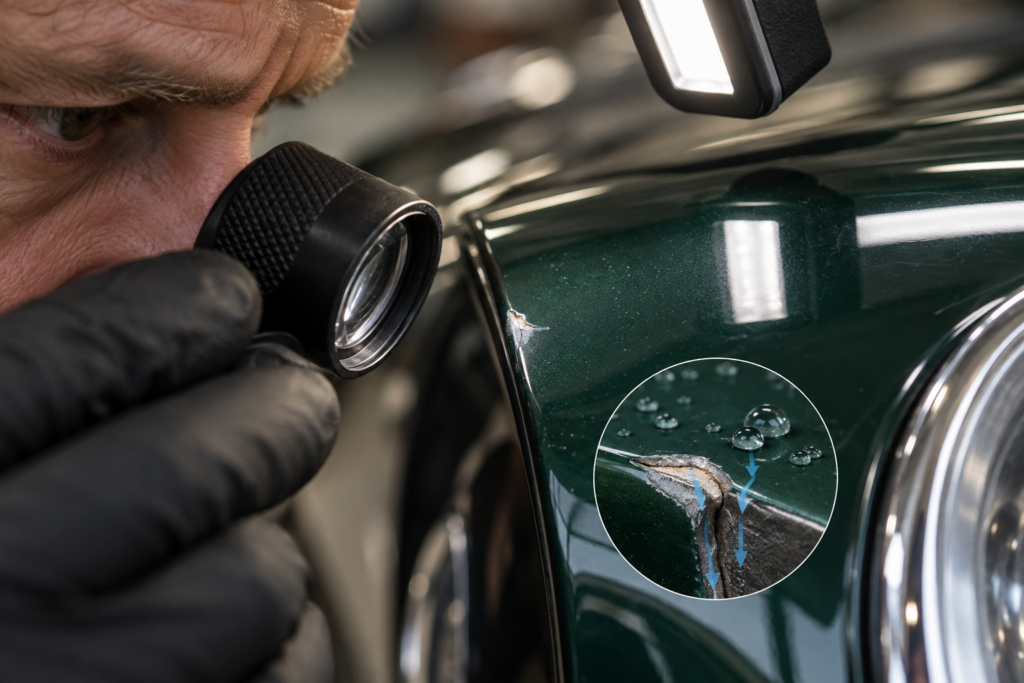
- Paint: intact, properly cured automotive coatings are designed to resist moisture. Humidity is more dangerous when paint is chipped, damaged, contaminated or covering metal that has already begun to corrode.
- Leather: leather absorbs and releases moisture. Very high humidity encourages mold and hydrolytic deterioration; excessively dry conditions can also make leather brittle.
- Electronics: moisture can promote corrosion, leakage paths and electrical faults, especially when condensation or ionic contamination is present.
- Metal: corrosion generally accelerates as relative humidity rises, and salts can make corrosion active at much lower humidity levels.
For a mixed-material collector car, the goal is usually a clean, dry, relatively stable environment rather than chasing the lowest possible humidity number.
A practical mixed-material storage range in the neighborhood of 45–55% RH is consistent with conservation guidance for leather and many stable metals, but it should be treated as an evidence-informed preservation range—not a universal Ferrari, Porsche, Lamborghini or collector-car manufacturer specification.
In this guide
- How humid is Orlando?
- What relative humidity actually means
- What humidity really does to automotive paint
- What humidity does to leather
- What humidity does to electronics
- What humidity does to steel, aluminum and other metals
- Why mold appears inside stored cars
- Why condensation is worse than a high RH number
- Why salt and contamination change the equation
- What about rubber, plastics and adhesives?
- What humidity should a collector-car garage be?
- Is air conditioning enough?
- How to test your garage before storing a collector car
- Warning signs your storage environment is too damp
- 10 Florida humidity myths
- Frequently asked questions
How humid is Orlando, really?
Florida humidity is not just a feeling.
The Florida Climate Center publishes long-term morning and afternoon relative-humidity observations supplied by NOAA’s National Centers for Environmental Information.
For Orlando, the published values show a strong daily pattern:
| Month | Morning RH | Afternoon RH |
|---|---|---|
| June | 88% | 58% |
| July | 90% | 59% |
| August | 91% | 61% |
| September | 91% | 61% |
| Annual | 88% | 55% |
Orlando Outdoor Relative Humidity
Source: Florida Climate Center / NOAA-derived observations. These are outdoor morning observations, not average indoor-garage conditions and not a prediction of what your garage does.
That caveat matters.
A garage can be:
- much drier than the outdoor air;
- nearly identical to outside;
- or occasionally worse if moisture enters and cannot escape.
Construction, insulation, HVAC, door leakage, slab moisture, roof exposure, air movement and how often the garage opens all affect the result.
Orlando’s 1991–2020 climate normals also show why summer moisture management deserves attention: normal rainfall totals are 8.05 inches in June, 7.46 inches in July, 7.69 inches in August and 6.37 inches in September.
For a collector car, the problem is not that the air is humid for one afternoon.
It is that the vehicle may spend months surrounded by warm, moisture-rich air with frequent rain events and repeated opportunities for condensation or water intrusion.
What relative humidity actually means
Relative humidity is not simply “how much water is in the air.”
It describes how much moisture the air contains compared with how much it could hold at that temperature.
That means the RH can change even if the actual amount of water vapor does not.
The National Park Service Museum Handbook explains the relationship this way: when temperature rises in a closed air volume, RH falls; when temperature falls, RH rises.
Why that matters to a car
Imagine a collector car sitting in a warm garage all afternoon.
The metal, glass, leather and electronics all warm up.
Then the temperature changes quickly—perhaps after a thunderstorm, overnight cooling or air conditioning turning on.
If a surface becomes cold enough relative to the surrounding moisture level, water vapor can condense on it.
That is the same physics that puts water on the outside of a cold glass.
Condensation is actual liquid water.
And actual liquid water is far more aggressive than merely seeing a high number on a humidity sensor.
What does Florida humidity actually do to automotive paint?
This is one of the areas where storage marketing often gets sloppy.
Humidity does not simply dissolve a healthy clear coat.
Modern automotive finishes are multilayer coating systems engineered specifically to protect the underlying body.
PPG describes the clear coat as the layer that protects the color coat while improving durability and appearance. Its OEM systems also use pretreatments and electrocoats specifically to improve corrosion resistance.
Likewise, BASF notes that properly cured polymer coatings can have excellent resistance to rain and humidity. The fact that a coating began as a waterborne product does not mean it remains water-soluble after curing.
So where does humidity become a paint problem?
Usually at the weak points.
1. Stone chips and exposed metal
PPG’s corrosion guidance identifies exposed bare metal and damaged paint film as common paths to corrosion.
If moisture reaches steel beneath a chip, seam or failed repair, corrosion can begin underneath what otherwise looks like good paint.
2. Panel seams and hidden cavities
Door bottoms, pinch welds, fastener points, older repair seams and areas where water can sit are more vulnerable than the center of a healthy clear-coated panel.
3. Contaminants sitting on the paint
Dust, minerals, salts, insect residue, bird droppings and other contamination can hold moisture against the surface or become chemically more aggressive in the presence of water.
PPG’s refinish guidance specifically notes that contaminants can create discoloration and loss of gloss and that the effect can accelerate with time and temperature.
4. Condensation and water spotting
Repeated moisture deposition and evaporation can leave mineral residues behind. That can create water spotting or etching even when the paint itself is structurally sound.
5. Existing corrosion underneath paint
Once corrosion is active under a coating, moisture can help the corrosion cell continue and eventually contribute to bubbling or loss of adhesion.
What humidity does to leather interiors
Leather is a very different material from automotive clear coat.
Leather is hygroscopic: it absorbs and releases moisture as the surrounding relative humidity changes.
The Canadian Conservation Institute’s leather guidance says:
- very dry conditions below about 30% RH can contribute to moisture loss and embrittlement;
- high humidity above about 65% RH encourages mold growth and hydrolytic degradation;
- and large RH fluctuations can progressively harden some vegetable-tanned leathers.
CCI recommends a stable 45–55% RH range for the museum preservation of leather objects.
Does that mean every Ferrari interior must be stored at exactly 50% RH?
No.
Automotive leather is often coated, pigmented, finished and combined with foams, adhesives, stitching, plastics and metal hardware.
A museum leather recommendation should not be confused with a factory storage specification for a specific vehicle.
But it gives us something valuable:
the direction of risk.
Leather generally does not want to live indefinitely in either a desert or a swamp.
What high humidity can look like inside a car
- musty odor;
- visible mold or mildew spots;
- surface tackiness or residue;
- damp-feeling carpet or seat surfaces;
- corrosion on seat hardware beneath otherwise good upholstery;
- and staining around seams or areas where moisture has been trapped.
Do leather conditioners prevent humidity damage?
Not by themselves.
A dressing cannot fix a damp storage environment.
In fact, excessive product residue can create another surface that collects dust or supports unwanted biological growth.
Use products appropriate for the exact upholstery finish and focus first on the environment.
What Florida humidity does to electronics
Electronics are where people tend to jump from a true principle to an exaggerated conclusion.
True principle:
Moisture can damage electronics.
Exaggerated conclusion:
Any humid garage will destroy a modern car’s electronics.
Modern automotive electrical systems are engineered to survive difficult environments.
But moisture becomes increasingly dangerous when combined with:
- electrical voltage;
- ionic contamination;
- failed seals;
- damaged connectors;
- water intrusion;
- and condensation.
Texas Instruments uses high-temperature/high-humidity electrical-bias testing specifically to accelerate corrosion mechanisms in semiconductor reliability testing.
NASA’s printed-circuit-board reliability guidance identifies moisture-related mechanisms including copper oxidation, ionic corrosion that can create opens or shorts, blistering and interfacial degradation.
What does that mean in a collector car?
The vulnerable areas are usually not sealed modules functioning exactly as designed.
They are more likely to be:
- old connectors with weakened seals;
- grounds with surface corrosion;
- previously repaired wiring;
- modules located near a leak path;
- convertible-top drains that overflow;
- water entering the trunk or footwell;
- aftermarket electronics;
- older fuse boxes;
- and any circuit exposed to actual condensation.
Why condensation matters so much
Surface moisture can create leakage paths or help dissolved contaminants become conductive.
Analog Devices notes that moisture, residues and humidity on printed circuit boards can create leakage resistance issues in sensitive circuits.
This is why the best electronic-storage strategy is not “keep the car as cold as possible.”
It is:
keep water out, keep the environment reasonably stable, avoid condensation and correct leaks quickly.
What humidity does to steel, aluminum and other metals
This is where humidity has its clearest direct effect.
Metal corrosion is an electrochemical process, and water helps provide the electrolyte needed for that process.
The Canadian Conservation Institute says that above roughly 65% RH, enough water can be adsorbed onto many clean metal surfaces for corrosion to accelerate significantly.
CCI also notes that moderate RH around 40–55% is generally adequate to keep corrosion risk low for the majority of stable metals in mixed collections.
But there is a huge qualifier:
contamination changes everything.
Salt lowers the humidity threshold for corrosion
CCI reports that salt-contaminated metals can corrode at much lower RH than clean metal.
That matters even in inland Central Florida.
A collector car may arrive in Orlando with:
- coastal salt contamination;
- sweat and fingerprints on bare hardware;
- chloride residues from previous environments;
- road film;
- acidic or alkaline cleaning residues;
- or contamination trapped in seams.
On a coastal car, the risk can be even greater.
What metal corrosion often looks like first
- orange rust on untreated steel;
- white oxidation on aluminum or zinc components;
- green corrosion products on copper/brass connectors;
- rust beginning around fasteners, seams and chips;
- brake-rotor surface rust;
- and tarnishing of exposed hardware.
Some superficial oxidation is normal and manageable.
The goal of good storage is to prevent repeated wetting and sustained high-moisture conditions from turning cosmetic oxidation into active deterioration.
Why mold appears inside stored collector cars
Mold needs moisture and something it can use as food.
A car interior can provide both.
Potential food sources include:
- dust;
- skin oils;
- food residue;
- organic fibers;
- leather dressings;
- carpet contamination;
- and dirt trapped in vents or seams.
The U.S. Environmental Protection Agency recommends keeping indoor RH below 60%, ideally between 30% and 50% where practical, as general building-moisture guidance.
EPA also emphasizes drying wet materials within roughly 24–48 hours after leaks or spills whenever possible.
The distinction matters
A car does not become moldy simply because the weather app says Orlando humidity is 90% at 7 a.m.
The question is whether the interior itself remains damp long enough for growth conditions to develop.
A car stored inside a clean, dry, controlled facility can live in humid Florida without having a humid interior.
A car stored in a closed garage after being put away wet can have a completely different outcome.
Condensation is often more important than the raw humidity number
This may be the single most useful concept in the article.
You can have high RH without visible liquid water.
You can also create condensation during a temperature change even when the environment seemed acceptable earlier.
Condensation can occur on:
- glass;
- metal body panels;
- brake components;
- cool drivetrain parts;
- electronic housings;
- and inside poorly ventilated cavities.
The National Park Service specifically warns that temperature and RH are linked through dew point and that changing temperature without accounting for moisture can create condensation risk.
A real-world Florida example
Suppose a car spends a warm humid day in an open garage.
Then the garage is rapidly cooled while the car’s materials are at different temperatures.
Or the opposite occurs: a cool car is brought into warm humid air.
If a surface temperature is below the dew point of the surrounding air, water can form on that surface.
That is why stability matters.
Why salt and contamination make humidity much more dangerous
Humidity by itself is one variable.
Humidity plus contamination is another problem entirely.
The Canadian Conservation Institute notes that pollutants, salts, dust and oils can materially increase corrosion risk.
Salt is especially important because it is hygroscopic—it attracts water.
This creates two lessons for collector-car owners:
1. Do not store a dirty car for months
Road film, coastal salt, bug residue, brake dust and grime do not become harmless because the car stopped moving.
2. Wash before storage—but dry completely
A clean car put away dry is very different from a clean car put away with water trapped in:
- mirrors;
- door seals;
- drain channels;
- wheel wells;
- underbody cavities;
- and carpet.
For a detailed storage checklist, see How to Prepare a Porsche, Ferrari or Lamborghini for Extended Storage.
What about rubber, plastics, seals and adhesives?
Humidity gets blamed for deterioration that is often driven more directly by heat, ultraviolet exposure, ozone, age and chemistry.
Rubber
Seals and hoses can age from heat, ozone, oxygen and time. Humidity is not usually the primary reason a weatherstrip becomes hard and cracked.
Plastics
Different plastics behave very differently. Some absorb moisture; others are relatively insensitive. Heat is often a major accelerator of plastic aging in a closed Florida garage.
Adhesives
Older headliners, trim adhesives and composite assemblies can suffer in hot, humid conditions, but the chemistry varies too much to prescribe one universal RH number.
Wood trim
Wood is hygroscopic and can expand and contract with changing RH. In older luxury and coachbuilt cars, repeated environmental swings can matter to veneers, joints and finishes.
This is another reason a mixed-material car generally benefits from a stable moderate environment rather than the driest possible environment.
What relative humidity should a collector-car garage be?
This is the question everyone wants answered with one number.
The evidence says the honest answer is more nuanced.
There is no universal published humidity specification that applies to every Ferrari, Porsche, Lamborghini, Corvette, classic car and restomod.
But conservation science gives us a useful framework.
| Relative Humidity | Practical Interpretation for Mixed-Material Vehicle Storage |
|---|---|
| Below 30% | Very dry. Excellent for inhibiting metal corrosion, but potentially too dry for long-term preservation of some leather, wood and organic materials. |
| 30–40% | Dry environment. Generally favorable to metals; monitor leather/wood if maintained here continuously for long periods. |
| 40–55% | Balanced mixed-material zone. Consistent with preservation guidance for many stable metals and leather. |
| 55–60% | Not automatically harmful, but worth monitoring—especially if the car is contaminated, older, already corroding or has damp interior materials. |
| Above 60% | General indoor-moisture guidance begins to become more cautious; mold and condensation risk deserve closer attention. |
| Above 65% persistently | Conservation guidance identifies a meaningful rise in mold risk for leather and faster corrosion risk for many metals. |
My practical target
For a mixed-material collector car, I would rather see a garage remain steadily around the middle of that range than bounce repeatedly between very dry and very damp conditions.
Stability, cleanliness and absence of water intrusion matter as much as the exact percentage.
Is air conditioning enough for collector-car storage in Florida?
Sometimes.
Sometimes not.
Air conditioning removes moisture while it cools, but temperature control and humidity control are not identical.
The U.S. Department of Energy notes that managing indoor humidity is particularly challenging in hot-humid climates and that modern cooling systems can control temperature without always removing enough moisture.
DOE also notes that oversized air-conditioning equipment can cycle too quickly and provide poor humidity removal.
That means a 74°F garage is not automatically a dry garage
Measure both temperature and RH.
If the garage stays cool but regularly sits at very high RH, the environment is not doing what you think it is doing.
When a dedicated dehumidifier can help
A properly sized, properly drained dehumidifier can address latent moisture separately from cooling.
But it also needs:
- reliable drainage;
- maintenance;
- clean filters;
- appropriate placement;
- and power-loss planning if the car will be unattended.
A climate-controlled facility should be able to explain how it manages the environment rather than simply showing you a thermostat.
How to test your garage before storing a collector car
You do not need a laboratory.
You need data.
Step 1: buy a reliable temperature/RH logger
A simple sensor that records readings over time is more useful than one instant reading.
Step 2: measure for at least one to two weeks
For a better picture, include:
- sunny days;
- rainy days;
- mornings;
- afternoons;
- overnight periods;
- and at least one period when the garage door is opened normally.
Step 3: place the sensor near the vehicle—not directly on an HVAC vent
You want to know what the car experiences.
Step 4: look for patterns, not one bad reading
A brief spike is different from spending twelve hours every night above 70% RH.
Step 5: inspect after heavy rain
Humidity control cannot compensate for actual water intrusion.
Look around:
- garage-door edges;
- floor drains;
- walls;
- roof penetrations;
- HVAC condensate lines;
- and slab edges.
If your garage environment concerns you, compare it with the decision framework in Climate-Controlled Car Storage vs. a Home Garage in Florida.
Warning signs your storage environment is too damp
Do not wait for visible rust holes.
Early clues include:
- musty interior odor;
- fogging or recurring condensation;
- visible mold dots on leather, belts or carpet;
- orange rust appearing on exposed hardware;
- green or white corrosion on electrical terminals;
- persistent damp carpet;
- water spots appearing while the car is parked indoors;
- rust returning quickly after cleaning;
- corrosion on brake hardware or fasteners beyond normal surface oxidation;
- and RH logs that remain above 60–65% for long periods.
If any of those appear, identify the moisture source before buying more detailing products.
What should “climate controlled” mean at a professional car-storage facility?
It should mean more than “the building has air conditioning.”
Before storing a valuable car, ask:
- Is the entire vehicle-storage area conditioned?
- Is relative humidity monitored?
- Is temperature monitored?
- Are conditions logged or simply spot-checked?
- What happens after a power outage?
- How is water intrusion detected?
- How are HVAC condensate and drainage managed?
- Can staff explain the normal environmental range?
- What happens if conditions move outside that range?
- How often are stored vehicles visually inspected?
Auto Vault Orlando’s current public site describes the Vault as climate controlled year-round and protected by 24/7 monitored security.
The public site does not currently publish a specific relative-humidity setpoint.
I would rather say that clearly than invent a number for marketing.
Owners who want the exact current operating details should ask during a private tour.
For the full due-diligence checklist, read What to Look for in Exotic Car Storage: 15 Questions to Ask Before You Choose a Facility.
10 myths about Florida humidity and collector cars
Myth 1: “Humidity directly fades paint.”
More accurate: UV exposure and heat are major paint-aging mechanisms. Humidity is more important when it creates condensation, keeps contaminants wet or supports corrosion beneath damaged coatings.
Myth 2: “The lower the humidity, the better.”
More accurate: Extremely low RH is excellent for many metals but can be too dry for leather, wood and some organic materials over long periods.
Myth 3: “Air conditioning means humidity is controlled.”
More accurate: Cooling and dehumidification are related but not identical. Measure the actual RH.
Myth 4: “Modern car electronics are waterproof.”
More accurate: Automotive electronics are designed for harsh environments, but failed seals, condensation, contaminants and standing water can still create serious problems.
Myth 5: “Inland Orlando doesn’t have corrosion problems because it isn’t coastal.”
More accurate: Coastal salt increases risk, but moisture, contaminants and exposed metal can support corrosion anywhere.
Myth 6: “Leather needs to be kept as dry as possible.”
More accurate: Leather can deteriorate at both humidity extremes. Stable moderate RH is usually a better preservation strategy.
Myth 7: “If the garage feels comfortable, the car is safe.”
More accurate: Human comfort is a poor environmental sensor. Use an RH logger.
Myth 8: “A car cover protects against humidity.”
More accurate: A breathable indoor cover can protect from dust, but a cover cannot correct a damp environment and can make problems worse if moisture is trapped beneath it.
Myth 9: “Starting the car once a month solves humidity problems.”
More accurate: Starting the engine does not fix a damp building, mold risk or corrosion environment.
Myth 10: “Climate-controlled storage makes a car maintenance-free.”
More accurate: Environment is only one part of storage. Tires, batteries, fluids, insurance, cleanliness and model-specific procedures still matter.
How Florida humidity should change your storage strategy
I would focus on five things.
The Florida Collector-Car Moisture Plan
1. Keep water out.
Fix leaks, drainage problems and wet carpet before worrying about the decimal point on a humidity meter.
2. Measure the environment.
Know what temperature and RH actually do over days and weeks.
3. Keep the car clean.
Salts, dust and contaminants make moisture more damaging.
4. Avoid condensation.
Stable conditions are better than dramatic temperature swings.
5. Match the environment to the whole car.
A collector car is a mixed-material object: metal, leather, electronics, plastics, rubber, adhesives, glass and sometimes wood all live in the same storage space.
That is the preservation problem.
The answer is not simply “make it cold” or “make it dry.”
The answer is to create a stable environment that keeps liquid water, persistent dampness and large swings away from the vehicle.
Frequently asked questions about Florida humidity and collector cars
What humidity is too high for a collector car?
There is no universal automotive cutoff, but persistent RH above 60–65% deserves attention. EPA recommends indoor RH below 60% for moisture/mold control, while conservation guidance identifies increased mold and corrosion risk above roughly 65% for leather and many metals.
What is the best humidity for a collector-car garage?
A stable range around 40–55% RH is a practical mixed-material preservation target based on conservation guidance for leather and stable metals. It is not a universal automaker specification, so model-specific requirements and actual facility conditions still matter.
Is 60% humidity bad for a classic car?
A brief period at 60% is not automatically harmful. Persistent exposure matters more, especially if the car has contamination, exposed metal, damp carpets or existing corrosion.
Is 70% humidity bad for a collector car?
Persistent RH around 70% creates a more favorable environment for mold and metal corrosion. If a garage routinely stays there for long periods, investigate dehumidification, HVAC performance and water intrusion.
Can humidity damage car paint?
Humidity alone is not usually the main cause of paint fading. The greater risks are condensation, contaminants, water spotting and corrosion beneath chips, seams or damaged paint.
Does humidity cause clear-coat failure?
Not usually by itself. Clear-coat failure is more closely associated with coating condition, UV exposure, heat, application quality and aging. Moisture can aggravate corrosion or deterioration when the coating has already been compromised.
Does humidity cause rust?
Humidity supplies moisture that supports electrochemical corrosion. Corrosion generally accelerates as RH rises, and salts or contaminants can make metals corrode at lower humidity levels.
Does humidity damage aluminum?
Aluminum naturally forms a protective oxide layer, but it can still corrode—especially in the presence of chlorides, dissimilar metals, trapped moisture or damaged protective coatings.
Does humidity damage car electronics?
It can. Moisture plus electrical bias and ionic contamination can promote corrosion, leakage paths and electrical faults. Condensation and actual water intrusion are generally more concerning than ordinary ambient humidity alone.
Can high humidity cause electrical gremlins?
Yes, especially where connectors, grounds, wiring repairs or seals are already compromised. Moisture can reveal marginal electrical connections that seemed fine in dry conditions.
Does humidity cause mold on leather seats?
High humidity can support mold growth on leather and surface contamination. Conservation guidance identifies RH above about 65% as favorable to mold growth on leather.
Can leather get too dry?
Yes. Very low humidity can contribute to loss of moisture and embrittlement. That is one reason “as dry as possible” is not the best rule for an entire collector car.
Is air conditioning enough for a collector-car garage?
Not necessarily. Air conditioning can remove moisture, but a cool garage can still have high RH. Measure the actual environment rather than assuming thermostat temperature tells you the humidity.
Do I need a dehumidifier in my Florida garage?
Only if measurements show the garage is staying too humid or condensation is occurring. A good HVAC system and well-sealed building may already provide adequate control.
Should I keep a dehumidifier running all summer?
That depends on measured conditions, equipment sizing, drainage and maintenance. A dehumidifier should solve a documented moisture problem rather than run blindly.
Can a car cover trap humidity?
Yes, particularly if the vehicle or cover is damp or the cover is non-breathable. Use a clean, breathable indoor cover only on a clean, dry vehicle.
Should I crack the windows during storage?
There is no universal rule. In a clean, controlled facility it may be unnecessary. In a humid or dusty garage it can actually introduce more moisture and contamination. Follow the storage environment and vehicle-specific guidance.
Should I leave moisture absorbers inside the car?
Desiccant products can help in some enclosed spaces, but they are not a substitute for fixing a damp garage or water leak. They also require monitoring and replacement.
Does Florida humidity affect brake rotors?
Yes. Bare iron brake rotors can develop surface rust quickly in humid or wet conditions. Light surface oxidation often clears during normal braking, but persistent moisture and long inactivity can create more significant corrosion.
Is coastal Florida worse for collector cars than Orlando?
Coastal salt exposure can materially increase corrosion risk because chlorides attract moisture and promote electrochemical corrosion. Orlando is inland, but cars that have been exposed to coastal environments can carry contaminants with them.
How do I know if my garage is too humid?
Use a temperature/RH data logger and review readings over at least one or two weeks, including rainy periods. Also look for condensation, musty odors, mold, corrosion and damp carpet.
Does Auto Vault Orlando publish its exact humidity setpoint?
The current public site describes the Vault as climate controlled year-round but does not publish a specific RH setpoint. Owners who want current operating details should ask the Auto Vault team during a private tour.
How this article was researched
This guide combines my experience around collector and performance cars with current climate, conservation, coatings and electronics research.
Sources reviewed include the Florida Climate Center’s NOAA-derived relative-humidity data for Orlando, 1991–2020 Orlando climate normals, the U.S. EPA’s moisture and mold guidance, the National Park Service Museum Handbook, Canadian Conservation Institute guidance for leather and metal objects, PPG’s automotive-refinish corrosion guidance, current Texas Instruments electronics-reliability guidance, and NASA printed-circuit-board moisture research.
Conservation guidance is used here to explain material behavior and preservation principles. It should not be treated as a factory storage specification for a specific automobile. Always follow manufacturer procedures and qualified technical advice when a particular vehicle has unique requirements.
Auto Vault Orlando · Central Florida
Don’t guess what your collector car is breathing.
Florida humidity does not automatically mean your car needs professional storage. But if your garage remains damp, experiences condensation or leaves you wondering what is happening while the car sits, measure it and compare the alternatives.
Auto Vault Orlando currently offers year-round climate-controlled vehicle storage, 24/7 monitored security, private/discreet access and battery-maintenance support.
Tour the Vault, ask how the environment is managed, and compare it with what your car experiences at home.