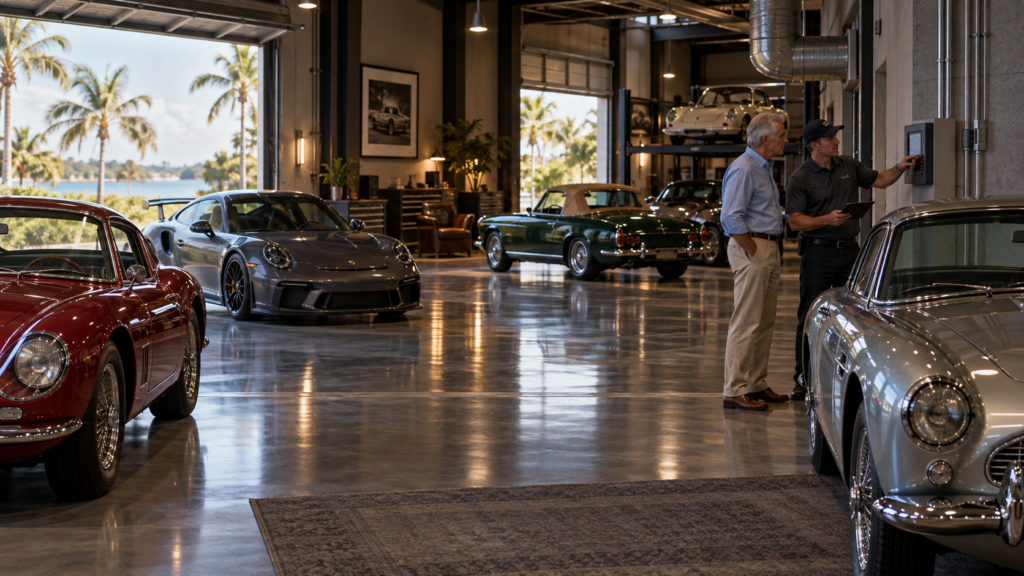

Automotive Community · Auto Vault Orlando
By Vincent Howard
Managing Partner, Auto Vault Orlando · Co-Founder, Chin Motorsports / Chin Track Days
Research reviewed September 2026 · Approximately 15-minute read
Car enthusiasts can meet at a Cars & Coffee for free, talk online all day and keep their cars at home. So why would anyone pay to join a private car club?
Because the best private automotive clubs are not really selling access to cars.
They are creating access to people, experiences, knowledge, convenience and a place where automotive enthusiasm is normal rather than something you have to explain.
After more than 25 years around performance driving, enthusiast events and automotive communities—including helping establish Chin Motorsports in 1999, now Chin Track Days—I have come to believe that cars are often what bring enthusiasts together, but they are rarely the only reason people keep showing up.
The relationships become part of the hobby.
Quick answer: Why do enthusiasts join private car clubs?
Enthusiasts join private car clubs primarily for community, exclusive experiences, convenient access to automotive activities, knowledge-sharing and a dedicated place to enjoy the hobby. Depending on the club, membership may also include vehicle storage, driving events, track access, simulators, concierge services, member lounges, technical education, social gatherings and access to other collectors.
The best private car club makes it easier to use, enjoy and share your automotive passion. The wrong club is simply another monthly fee.
In this guide
- Why private clubs are different
- Community and belonging
- A reason to actually use the cars
- Access to enthusiast knowledge
- Experiences that are difficult to create alone
- Storage and ownership convenience
- The automotive “third place”
- Relationships beyond cars
- Different types of car clubs
- When membership is worth it
- How Auto Vault Orlando fits
- Frequently asked questions
Private car clubs are not just traditional car clubs with nicer furniture
The term car club covers several very different experiences.
A marque club might organize around Porsche, Ferrari, Corvette, BMW or a specific collector category. A Cars & Coffee group may have no dues at all. A track club can revolve around high-performance driving. A storage-and-social club may provide a permanent home for both the member and the vehicle.
The modern private automotive club increasingly combines several of those experiences.
Hagerty Garage + Social, for example, combines climate-controlled collection storage with social spaces, member drives, track days, tours, rallies, educational events and vehicle-care coordination.
The Concours Club in South Florida describes itself as an automotive country club combining performance driving, concierge service, hospitality and a calendar of automotive, cultural and social events.
Florida’s P1 Motor Club takes another approach: a motorsports-centered private community with track access, a clubhouse, family amenities, driving programs and optional automotive real estate.
The models are different, but the underlying idea is similar:
The car becomes the common language. The club gives people somewhere to speak it.
Car enthusiasts are already highly social
The stereotype of the collector quietly hiding cars in a garage misses a significant part of modern enthusiast culture.
Recent Hagerty enthusiast research points in the opposite direction.
Automotive Community Participation Signals
Source: Hagerty enthusiast and agent-market research available in 2026. These figures reflect Hagerty research audiences and should not be interpreted as a census of all U.S. vehicle owners.
Hagerty’s broader collector-market research also identifies fun to drive, visual appeal and personal nostalgia among the top reasons enthusiasts own collector vehicles.
Those are emotional and experiential motivations.
A private club can extend them beyond the car itself.
1. The biggest benefit is usually the simplest: finding your people
Many enthusiasts know the experience.
You start explaining why a naturally aspirated engine matters, why a particular chassis code is special, why you drove two hours to look at a car you weren’t planning to buy—or why waking up before sunrise to watch Formula 1 seems completely reasonable.
Then the other person’s eyes glaze over.
A good automotive community removes that friction.
You don’t have to start by explaining why cars matter. Everyone already understands the premise.
Traditional clubs have delivered that benefit for decades. Hagerty’s guide to classic-car clubs identifies community as one of their central advantages: members begin with an immediate shared interest and often build relationships far beyond the automobile itself.
That dynamic is central to the philosophy behind Auto Vault Orlando as well. The cars create the introduction. The goal is to give the people behind them reasons to keep gathering.
2. A club gives you a reason to actually use the car
One of the contradictions of collector and exotic-car ownership is that people can spend years searching for a special car and then barely drive it after buying it.
There are understandable reasons:
- life gets busy;
- organizing a drive takes effort;
- the car isn’t convenient to access;
- you don’t have anyone to go with;
- you worry about mileage;
- or there is simply no event on the calendar compelling you to pull the cover off.
A club changes that.
Breakfast drives. F1 watch mornings. Cars & Coffee. Rallies. Technical sessions. Track days. New-model previews. Charity events. Road trips. Dinners. Member showcases.
The event itself may be simple.
Its real value is that it creates a date on the calendar when the car gets driven instead of admired from ten feet away.
That is why organizations such as Hagerty Garage + Social explicitly build drives, track days, tours and rallies into the membership experience.
At Auto Vault Orlando, the same idea carries into automotive gatherings, member experiences and community events around Central Florida.
3. You gain access to knowledge Google cannot completely replace
There is no shortage of automotive information online.
There is still a difference between information and experience.
An owner who has put 40,000 miles on the exact model you are considering can tell you things a specification sheet cannot.
A longtime collector may know which specialist actually understands an unusual marque. Another member may have already solved the battery problem you’re experiencing. Someone else may know which aftermarket modification appears attractive but creates headaches five years later.
Club conversations can help with questions such as:
- Which local specialist really knows this model?
- What fails as the car ages?
- Which maintenance items should be preventive rather than reactive?
- Where can an obsolete part be sourced?
- What is a fair market price for an unusual specification?
- Which driving events are well organized?
- Who provides reliable enclosed transportation?
- Which detailer would you trust with a difficult finish?
- Is a modification reversible?
- What would you buy differently the second time?
Hagerty similarly identifies access to accumulated owner knowledge as a major advantage of traditional clubs.
Private clubs can intensify that effect by putting the same people in the same place repeatedly.
4. Clubs make experiences easier to access
An enthusiast can organize nearly anything independently.
You can rent a simulator. Arrange a group drive. Reserve an event venue. Find track time. Organize a Formula 1 watch party. Schedule vehicle transport. Book a photographer.
The question is whether you actually will.
There is a convenience value in having automotive experiences already organized around you.
Modern clubs increasingly compete on exactly that dimension.
| Club experience | What it removes |
|---|---|
| Organized drives | Route planning, recruiting participants and coordination |
| Member events | Finding worthwhile automotive activities |
| Track programs | Some of the logistical barriers to performance driving |
| Club lounges | Finding a place where enthusiasts can simply gather |
| Simulators | Owning and maintaining sophisticated equipment at home |
| Storage | Home-space constraints and some vehicle-care friction |
| Concierge coordination | Time spent arranging service, transport or detailing |
| Technical events | Finding credible specialists and educational opportunities |
Time is part of membership value.
For a busy enthusiast, removing friction can be more valuable than adding another amenity.
5. For collectors, a private club can solve the “where do I put the next car?” problem
Not every private automotive club provides vehicle storage.
But storage-and-social clubs address a practical constraint that eventually affects many collectors: garage space.
The progression is familiar.
One enthusiast car fits easily. Two works. Three starts changing how the garage functions. Eventually something desirable appears for sale and the question isn’t only, “Do I want it?”
It’s:
“Where am I going to put it?”
Professional storage can separate the size of a collection from the number of garage bays attached to your home.
It can also create a different ownership experience by combining vehicle care with the place where the social side of the hobby happens.
At Auto Vault, membership and vehicle storage are separate but complementary experiences. An enthusiast does not have to store a car to join the club, while storage members can keep a vehicle close to the community around it.
If you’re deciding whether professional storage makes sense at all, our comparison of luxury-car storage versus a traditional home garage goes deeper into the trade-offs.
Florida owners should also factor in environmental conditions. See our guide to storing a classic or collector car and our discussion of security considerations for high-value vehicle storage.
6. A great private car club becomes an automotive “third place”
There is another benefit that doesn’t fit neatly into a dues calculation.
People generally have a home and a workplace.
A useful social club creates another place they actually want to spend time.
For an enthusiast, that can mean stopping by even when there is no formal event.
You may have coffee, work for an hour, run a few laps on a simulator, look at what’s around the facility, talk with someone about a car they just acquired and leave having done nothing particularly important.
That may be exactly the point.
Hagerty Garage + Social explicitly describes this clubhouse behavior: members are encouraged to stop in, have coffee, admire cars and spend time with other enthusiasts even without a scheduled event.
That separates a real club from an event calendar.
A successful club has value between the events.
7. Repetition turns acquaintances into an actual community
Cars & Coffee is one of the best entry points into automotive culture.
I am a fan of open community events for exactly that reason.
But they can also be transient.
You may see someone once, admire the car, talk for ten minutes and never cross paths again.
Private membership changes the frequency of interaction.
The same people see each other at a watch party, then a drive, then an ordinary afternoon in the lounge, then another event.
That repetition matters.
A club doesn’t manufacture friendship. What it can do is create the conditions in which relationships have a chance to develop naturally.
8. The network often becomes useful far beyond automobiles
This is a benefit I would be careful not to oversell.
You should not join a car club because you expect a room full of wealthy prospects.
That is a good way to become the person nobody wants to talk to.
But automotive communities naturally bring together people from different professions, businesses, industries and backgrounds.
If relationships are built around genuine shared interests first, other connections can follow.
Members may eventually become:
- friends;
- business relationships;
- clients;
- advisors;
- vendors;
- driving partners;
- charity collaborators;
- or simply the person you call when you need an informed opinion.
The distinction matters.
Community first. Networking second.
9. Private clubs expose you to cars you may never have considered
Enthusiasts naturally develop tribes.
Porsche people know Porsche people. Ferrari owners know Ferrari owners. BMW drivers end up around BMWs. Vintage American collectors often spend time with other vintage American collectors.
A broader private automotive club can break those silos.
You might arrive thinking you have no interest in pre-war cars and spend an hour talking with someone who understands their history.
You may discover that the Japanese performance car you dismissed fifteen years ago has become fascinating.
You may hear an analog V12 start from ten feet away and reconsider an entire category.
The best automotive spaces create cross-pollination between generations, marques and types of enthusiasm.
That is healthy for the hobby.
10. The best clubs include the next generation
Automotive culture has to be transferred.
If younger enthusiasts never get near interesting cars, talk to experienced owners or see the hobby as something accessible rather than guarded, collector culture eventually shrinks.
That doesn’t mean every private club needs to become a public museum.
It does mean families, guests, younger drivers and new enthusiasts matter.
Modern clubs increasingly recognize this. P1 Motor Club, for example, specifically structures portions of its membership around family participation rather than treating the enthusiast’s spouse or children as an afterthought.
The long-term health of car culture depends on someone becoming fascinated by a machine they didn’t know existed yesterday.
11. Membership can make ownership less transactional
If the only time you interact with the automotive world is when something needs repair, ownership can become surprisingly transactional.
Buy the car.
Pay the insurance.
Service the car.
Wash the car.
Store the car.
Sell the car.
A community adds experiences between those transactions.
That’s important because vehicles that are purely financial objects are easy to evaluate only by depreciation and cost.
The more a car produces experiences, relationships and memories, the more complete the ownership equation becomes.
What kind of car club are you actually looking for?
Not every enthusiast should join the same kind of club.
| Club type | Best for | Typical strengths | Potential limitation |
|---|---|---|---|
| Marque club | Owners passionate about one manufacturer/model | Deep technical knowledge, history, model-specific events | Narrower automotive exposure |
| Local informal club | Social enthusiasts | Low cost, accessibility, local drives | Less infrastructure and consistency |
| Cars & Coffee community | Broad enthusiasts | Open access, variety, easy entry into hobby | Relationships can remain casual/transient |
| Storage + social club | Collectors and busy enthusiasts | Clubhouse, events, community, vehicle storage/services | Recurring dues/storage cost |
| Private track club | Performance-driving enthusiasts | Track access, instruction, driving community | Higher cost and narrower use case |
| Automotive country club | Enthusiasts seeking broader lifestyle experience | Driving, hospitality, family amenities, events | Can involve substantial initiation and annual fees |
National examples illustrate how broad the category has become.
Hagerty Garage + Social centers storage, collection management and social experiences. The Concours Club combines high-performance driving with hospitality. M1 Concourse emphasizes circuit access and driver development. P1 Motor Club is building an integrated motorsports and lifestyle community.
None of those models is inherently “better.”
The correct model is the one that aligns with how you actually enjoy cars.
Is private car club membership worth it?
Sometimes.
But not automatically.
Here is the test I would use.
The Private Car Club Value Equation
Community you actually use + experiences you attend + convenience you value + amenities you use + knowledge/access you gain
÷
Dues + initiation fee + time + distance + restrictions
If you live 90 minutes away and attend one event a year, an impressive clubhouse may provide little value.
If you stop in weekly, attend race mornings, meet people for drives, use the simulators, store a car there and build meaningful relationships, the calculation looks very different.
The Auto Vault Private Car Club Fit Test
Score each factor from 0 to 3.
| Question | 0 | 1 | 2 | 3 |
|---|---|---|---|---|
| How often would you realistically visit? | Almost never | Quarterly | Monthly | Weekly+ |
| Do you want more automotive friendships? | No | Maybe | Yes | Major goal |
| Would you attend club events? | No | A few | Regularly | Frequently |
| Would you use automotive amenities? | No | Rarely | Sometimes | Frequently |
| Do you need or value vehicle storage? | No | Maybe later | Useful | Important |
| Does convenience matter? | Little | Somewhat | A lot | Very much |
| Would you benefit from other enthusiasts’ knowledge? | Little | Somewhat | Yes | Strongly |
| Do cars occupy a meaningful part of your lifestyle? | Not really | Occasionally | Yes | Absolutely |
| 19–24 | Strong fit. You are likely to use enough of the community and experience to justify exploring membership. |
| 13–18 | Potential fit. Tour the club and identify which benefits you would realistically use. |
| 7–12 | Questionable fit. Open automotive events may provide most of what you want. |
| 0–6 | Probably not worth it. Membership risks becoming another subscription you don’t use. |
When a private car club probably isn’t worth it
I would not recommend membership simply because someone owns an exotic or collector car.
Ownership and club membership are separate decisions.
A private automotive club may not be worth the expense if:
- you prefer solitary driving;
- you rarely attend automotive events;
- the club is inconveniently located;
- you already have a strong automotive community elsewhere;
- the amenities do not match your interests;
- you feel obligated to join because of the car you own;
- or dues would bother you every month more than the club would improve your life.
A free Cars & Coffee and a few close enthusiast friends can be more valuable than an expensive membership you barely use.
Exclusivity alone is not value.
Questions to ask before joining any private automotive club
- Who actually belongs? Is the culture welcoming and compatible with you?
- How often do members use the facility?
- What events happened in the last six months? Ask about completed events, not just planned ones.
- What is included versus à la carte?
- Are guests allowed?
- Are family members included?
- Is vehicle ownership required?
- Is storage required?
- What are the access hours?
- What is the cancellation policy?
- How many members are there?
- Does membership capacity affect access?
- What services are actually performed in-house versus coordinated externally?
- Can you tour before committing?
- Would you still join if nobody knew you were a member?
That last question eliminates a lot of bad reasons.
Where Auto Vault Orlando fits
Auto Vault Orlando is being built around the storage-and-social model rather than the traditional marque-club model.
The club is not limited to one manufacturer, one period or one type of enthusiast vehicle.
The shared qualification is simpler: the car matters to you.
Current member amenities include more than 8,000 square feet of club space, a members lounge, professional racing simulators, a golf simulator, Formula 1 watch experiences, a podcast studio, conference space and automotive gatherings.
Membership is also separate from storage. You do not have to store a vehicle at Auto Vault to become a member.
That is intentional.
Someone may have an excellent garage at home and still want a community. Another member may primarily need climate-controlled vehicle storage and ownership support. A third may use the lounge, events and simulators far more than the storage facility.
The current Auto Vault Orlando membership structure offers Social, Performance and limited Founder levels so enthusiasts can choose different levels of access rather than paying for one identical membership package.
You can also see the Auto Vault environment before visiting.
But I would make the same recommendation here that I would make about any private club:
Tour it before joining.
Websites can show amenities.
The important question is whether the people and environment feel like somewhere you want to return.
Frequently asked questions about private car clubs
What is a private car club?
A private car club is a membership-based automotive community that provides access to experiences, facilities or services not generally available to the public. Depending on the club, this can include a clubhouse, vehicle storage, social events, track access, drives, simulators, concierge services, dining or other automotive amenities.
Why do people join private car clubs?
The most common reasons include meeting other enthusiasts, participating in automotive events, gaining access to specialized experiences, learning from experienced owners, simplifying aspects of vehicle ownership and having a dedicated place to enjoy automotive culture.
Do you need an exotic car to join a private car club?
No. Requirements vary by club. Some clubs focus on specific marques, collector vehicles or performance cars, while others welcome enthusiasts regardless of what they own. Auto Vault Orlando does not require a member to store a vehicle with the club.
Are private car clubs only for wealthy collectors?
No, although some automotive country clubs and track clubs involve substantial initiation fees. Other clubs offer relatively accessible social memberships. The category ranges from local enthusiast organizations to six-figure private motorsports clubs.
How much does a private car club membership cost?
There is no standard price. Traditional enthusiast clubs can cost relatively little, while premium storage-and-social clubs charge recurring monthly dues and high-end private track clubs can require significant initiation fees. Compare the cost with the benefits you will actually use rather than the longest list of amenities.
What are the benefits of joining a car club?
Benefits can include community, technical knowledge, organized drives, social events, track opportunities, discounts, vehicle-storage options, maintenance coordination, travel experiences, access to specialists and friendships with people who share the same automotive interests.
Are private car clubs good for networking?
They can create valuable professional relationships because members share repeated experiences, but networking should be a secondary benefit rather than the reason you join. Genuine relationships built around common interests tend to create better connections than treating the club like a prospecting list.
Can a private car club store my vehicle?
Some can. Storage-and-social clubs combine secure collector-car storage with membership amenities, while traditional clubs may provide no storage at all. Review environmental controls, security, access procedures, insurance requirements and vehicle-care services before choosing a storage facility.
What’s the difference between a car club and Cars & Coffee?
Cars & Coffee is generally an open or loosely organized event where enthusiasts gather periodically. A private club creates ongoing membership, repeated interaction and often a permanent facility, member calendar and additional services.
What’s the difference between a private car club and a country club?
A traditional country club is generally centered on golf, dining, recreation and social activity. An automotive country club applies a similar membership model around cars and driving, sometimes adding private circuits, garages, clubhouses, dining and hospitality.
Are there private car clubs in Florida?
Yes. Florida has several styles of automotive membership communities, from local enthusiast clubs and storage-social clubs to major motorsports developments. Auto Vault Orlando serves Central Florida, The Concours Club operates in the Miami area, and P1 Motor Club is developing a large private motorsports community on Florida’s Treasure Coast.
Is a private car club membership tax deductible?
Generally, don’t assume so. The tax treatment of club dues depends on the circumstances and applicable tax rules. Consult your tax professional rather than treating personal automotive-club dues as a business expense simply because networking sometimes occurs there.
Is joining a private car club worth it?
It is worth considering when you will regularly use the community, events, facilities or services and the dues comfortably fit your discretionary budget. If you rarely attend, live too far away or primarily want occasional car events, free enthusiast gatherings may provide better value.
How this article was researched
This guide combines Vincent Howard’s long-term experience in automotive enthusiast and performance-driving communities with current research into traditional car clubs, collector-car participation and modern private automotive-club models.
Research reviewed for this article included Hagerty’s collector and exotic-car enthusiast data, Hagerty Garage + Social, The Concours Club, P1 Motor Club, M1 Concourse and current Auto Vault Orlando membership, event and facility information.
The club examples are included to illustrate different membership models rather than rank or endorse one organization over another. Membership offerings, pricing, access and amenities can change, so prospective members should verify current information directly with any club they are considering.
Auto Vault Orlando · Central Florida
The cars get you through the door. The people bring you back.
If you’re looking for more than somewhere to park an exceptional car, experience Auto Vault Orlando in person.
See the climate-controlled Vault, members lounge, simulators and club spaces—and decide for yourself whether the community fits the way you enjoy cars.