Exotic Car Storage & Preservation · Auto Vault Orlando
By Vincent Howard
Managing Partner, Auto Vault Orlando · Co-Founder, Chin Motorsports / Chin Track Days
Research reviewed September 3, 2026
Putting a Porsche, Ferrari or Lamborghini into storage is easy. Putting one into storage correctly is a different matter.
Modern exotic and high-performance cars remain electronically active when parked. Tires can take a set. Batteries discharge. Florida heat and humidity continue working on paint, leather, rubber and electrical systems even when the odometer isn’t moving.
And the more technologically sophisticated the car becomes, the less useful generic advice such as “disconnect the battery and start it once a month” becomes.
After more than 25 years around enthusiast and performance cars, and now through our work at Auto Vault Orlando, one principle has become particularly important to me:
The correct storage procedure belongs to the specific car—not merely the badge on its hood.
A 458 Italia does not necessarily have the same storage requirements as an SF90. A 991-generation Porsche 911 is not a Taycan. A Huracán is not a Revuelto.
This guide explains the universal principles, the manufacturer differences and the mistakes I would avoid.
Quick answer: How should you prepare a Porsche, Ferrari or Lamborghini for extended storage?
Before extended storage, thoroughly clean and dry the vehicle, bring scheduled maintenance current, inspect fluids and tires, use the correct manufacturer-approved battery maintenance strategy, store the vehicle indoors in a clean and controlled environment, protect it against moisture and pests, and follow the exact owner’s-manual procedure for tire pressure, parking brake, fuel and hybrid/high-voltage systems.
Do not automatically copy another exotic owner’s routine. Tire pressures, battery chemistry, parking systems and high-voltage charging requirements can differ even within the same manufacturer.
In this guide
- What counts as extended storage?
- Start with the exact owner’s manual
- Service the car before storing it
- Clean and dry the vehicle
- Battery maintenance
- Tires and flat spotting
- Fuel and fluids
- Parking brake and transmission
- Climate and humidity
- Car covers
- Hybrid and high-voltage exceptions
- Should you start the car periodically?
- Porsche vs. Ferrari vs. Lamborghini
- Florida-specific storage
- Returning the car to service
- Frequently asked questions
What counts as extended vehicle storage?
There is no universal number of days when ordinary parking suddenly becomes “long-term storage.”
But once a performance car is likely to remain stationary for several weeks or months, I start thinking differently about it.
| Storage period | Main concerns | Preparation level |
|---|---|---|
| 1–2 weeks | Battery state, tire pressure, secure environment | Basic |
| 2–8 weeks | Battery maintenance, tire flat spotting, climate, cleanliness | Moderate |
| 2–6 months | All of the above plus fuel age, service condition, moisture, pests and restart procedure | Full storage preparation |
| 6–12+ months | Long-term preservation plan, periodic inspections and model-specific specialist guidance | Professional preservation strategy |
The more valuable, unusual or electronically complex the car, the less I would improvise.
1. Start with the VIN-specific owner’s manual
This step sounds obvious, but it prevents many bad assumptions.
Porsche makes current manuals available digitally through PCM, the My Porsche app and its online owner’s-manual system. Owners can select a model year or use vehicle-specific information. See Porsche’s official owner’s-manual guidance.
Ferrari and Lamborghini owners should likewise use the handbook supplied with their specific vehicle or contact the authorized service network when the storage procedure is unclear.
Why?
Because generic advice can directly conflict with model-specific guidance.
Consider tire pressure.
Michelin’s current flat-spotting guidance recommends keeping tires at the vehicle manufacturer’s placard pressure and explicitly advises against overinflating simply to prevent flat spots.
But manuals for some older Ferraris instructed owners preparing those specific cars for long storage to use approximately 3.0 bar and periodically move the tire contact point.
Those statements aren’t permission to choose whichever number sounds better.
They demonstrate why the exact vehicle procedure takes priority over somebody else’s Ferrari, Porsche or Lamborghini routine.
2. Put the car away healthy—not overdue for service
Storage does not fix deferred maintenance.
If the car is due for annual service, brake fluid, an oil service or another time-based maintenance item, I would rather address it before storage than discover the issue when I want to drive six months later.
That does not mean automatically replacing every fluid simply because a car is being parked.
Follow the actual maintenance schedule.
Ferrari’s Genuine Maintenance Programme, for example, emphasizes scheduled maintenance based on time or mileage and factory-trained inspection rather than arbitrary fluid replacement.
Lamborghini similarly describes its scheduled maintenance program as part of maintaining performance, reliability and long-term vehicle condition.
Before storage, I want to know:
- Is the car current on scheduled maintenance?
- Are there active warning lights?
- Are there fluid leaks?
- Is brake fluid within its service interval?
- Is coolant at the correct level and specification?
- Is engine oil at the correct level?
- Are belts, hoses and seals showing problems?
- Are tires healthy enough to remain on the vehicle?
- Is the battery already weak?
- Are recalls or campaigns outstanding?
Storage should preserve a healthy car—not postpone solving an unhealthy one.
3. Wash the car, but don’t store it wet
Contaminants left on paint for months can become much harder to correct later.
Before extended storage:
- Wash the exterior properly.
- Remove bugs, bird residue and road contamination.
- Clean the wheels and brake-dust buildup.
- Dry the exterior thoroughly, including seams and crevices.
- Clean and vacuum the cabin.
- Remove food and anything that can attract pests.
- Make sure carpets and mats are dry.
- Remove damp detailing towels or other moisture-holding items.
I would rather store a slightly dusty dry car than a perfectly washed car that still has moisture trapped in body seams or the interior.
Florida makes that particularly important.
4. Battery maintenance is not optional on many modern exotics
Modern performance cars consume electrical power even while parked.
Alarm systems, remote access, telematics, control modules and convenience functions can all create parasitic draw.
Porsche explicitly recommends a battery maintainer when a vehicle will experience prolonged storage. Its current service literature says owners who drive fewer than 6,000 miles annually or anticipate prolonged storage should consider a maintainer. See Porsche’s owner resources and the instructions for your exact vehicle.
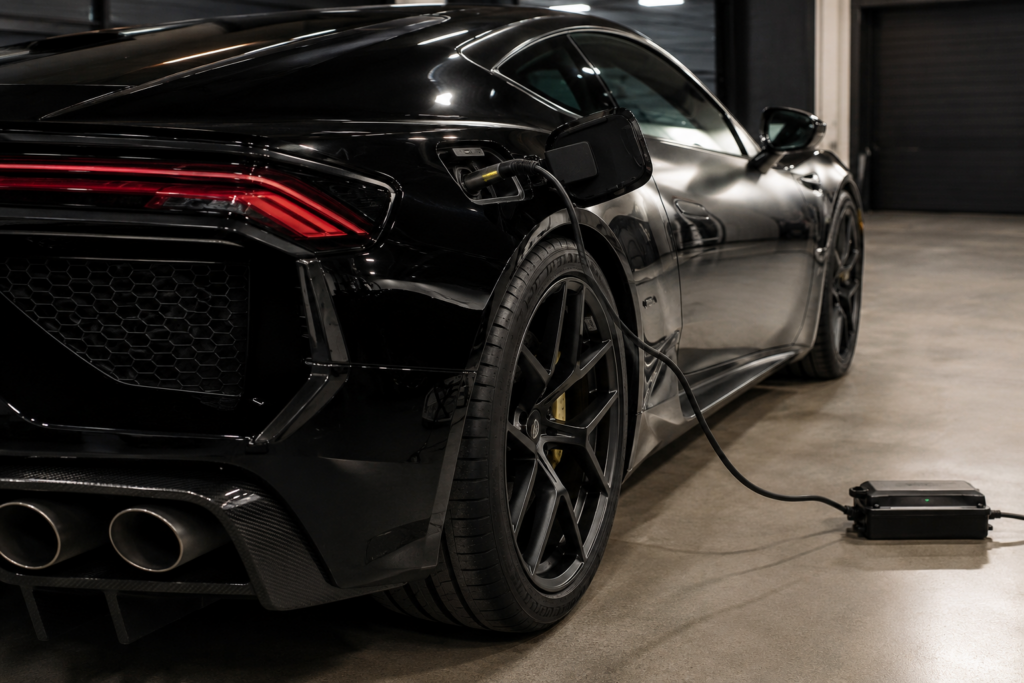
Ferrari takes battery maintenance seriously enough to offer a Ferrari Genuine battery conditioner, and long-storage procedures for several Ferrari generations instruct owners to connect the specified conditioner.
Lamborghini’s current accessories program likewise offers a battery maintainer for Huracán, while the current Urus accessory system describes a maintainer with recognition software compatible across Lamborghini models.
What I would not do
I would not connect a random charger merely because its clamps fit the battery.
The vehicle may use:
- conventional lead-acid;
- AGM;
- lithium-ion;
- dual electrical systems;
- or separate low-voltage and high-voltage batteries.
Use equipment approved for the vehicle’s battery chemistry and connection method.
Battery Storage Decision
Combustion-only exotic:
Use the correct low-voltage battery maintenance procedure specified by the manufacturer.
Hybrid exotic:
Treat the low-voltage and high-voltage systems as separate systems and follow the model-specific instructions for each.
Unknown battery chemistry:
Stop and identify it before connecting a charger.
5. Protect the tires without inventing a pressure number
Performance tires are expensive, highly loaded and often use relatively stiff constructions that make temporary flat spotting noticeable after the car sits.
Michelin explains that temporary flat spotting can occur when a tire remains loaded in one position and that the vibration often disappears after the tire warms through normal driving.
Its current recommendation is simple: maintain the vehicle manufacturer’s recommended placard pressure and do not overinflate simply in an attempt to prevent flat spotting.
Read Michelin’s current guidance on tire flat spotting and tire storage.
For a stored exotic car:
- Set pressure according to the vehicle/tire manufacturer’s storage guidance.
- Inspect the tires before storage.
- Check DOT age as well as tread depth.
- Keep them away from excessive heat and ozone sources.
- Recheck pressure periodically during long storage.
- If the manufacturer instructs periodic vehicle movement, follow that procedure.
- Inspect before returning to high-speed use.
What about tire cradles?
They can be useful operationally, but I would not market them as a guaranteed cure for flat spotting. Michelin says it does not have data proving tire cradles prevent the condition and continues to emphasize correct inflation and proper storage conditions.
Should I put a Porsche, Ferrari or Lamborghini on jack stands?
Not by default.
Exotic cars may have specific lift points, carbon-fiber underbody structures, hydraulic lift systems, active suspension or other considerations.
If complete load removal is contemplated for very long storage, get the procedure from the manufacturer or qualified marque specialist rather than putting a six-figure car on generic stands because an online checklist told you to.
6. Don’t make fuel advice more universal than it really is
Fuel is one of the areas where internet storage advice becomes too confident.
You’ll see recommendations to:
- fill the tank completely;
- leave it partially full;
- add stabilizer;
- use ethanol-free gasoline;
- or drain fuel entirely.
Those are not interchangeable strategies.
Fuel-system materials, tank design, emissions equipment and storage duration vary.
My general approach is:
- Use fuel that meets the manufacturer’s required octane and specification.
- Do not enter storage with old or questionable fuel.
- For truly long storage, confirm the fuel procedure with the exact owner’s manual or authorized specialist.
- Do not introduce additives the manufacturer has not approved merely because somebody recommended them online.
If the storage period unexpectedly becomes much longer than planned, the restart procedure should account for fuel age.
7. Be careful with the parking brake
Another common oversimplification is:
“Always leave the parking brake on.”
That is not universally good storage advice.
Some older Ferrari long-storage instructions specifically tell owners to secure the vehicle using the transmission rather than relying on the handbrake. Porsche dealer guidance for long-term storage has similarly advised against leaving the parking brake applied on certain vehicles because of possible pad adhesion.
Modern electric parking brakes, Park Lock systems and hybrid drivetrains complicate the issue further.
So the rule is:
Use the exact manufacturer storage procedure.
If the approved procedure involves leaving the parking brake released, the vehicle must still be safely prevented from moving with the appropriate gear/park setting and properly placed wheel chocks.
8. Control the environment around the car
The environment continues interacting with a parked vehicle every hour it sits.
That is especially relevant in Central Florida.
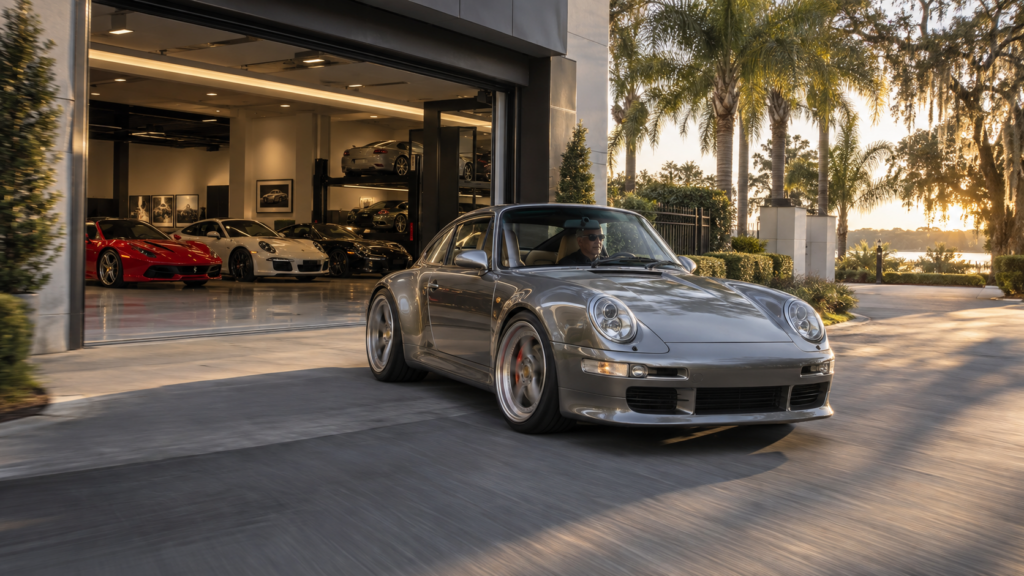
At Auto Vault Orlando, our Vault is climate controlled year-round and monitored 24/7 because storage isn’t only about keeping rain off a vehicle.
Florida owners should think about:
- heat;
- humidity;
- condensation;
- storm exposure;
- UV exposure;
- dust;
- pests;
- security;
- electrical power for battery maintenance;
- and access for periodic inspection.
We’ve explained the environmental side in more detail in Why Climate-Controlled Car Storage Matters for Luxury & Exotic Cars.
If you’re deciding between home and professional storage, read our comparison of professional luxury-car storage versus a traditional garage.
Storage environment checklist
| Dry | No water intrusion, wet flooring or persistent condensation. |
| Temperature controlled | Avoid repeated exposure to extreme heat and large temperature swings where possible. |
| Humidity managed | Reduce prolonged high-humidity exposure. |
| Clean | Keep airborne contaminants and dust under control. |
| Pest controlled | Prevent rodent or insect access without placing harmful chemicals against the vehicle. |
| Secure | Controlled access, monitoring and appropriate insurance. |
| Powered | Safe electrical access where approved battery-maintenance equipment is required. |
For high-value vehicles, security deserves its own evaluation. See our guide to high-security supercar storage.
9. Use a cover only on a clean, dry car
An indoor cover can be useful for controlling dust and protecting against incidental contact.
It can also trap contamination against the paint if the car is dirty.
For long-term indoor storage:
- clean the car first;
- make sure it is completely dry;
- use a soft, properly fitted indoor cover;
- avoid abrasive fabric;
- avoid impermeable material that traps moisture;
- and don’t drag the cover across a dusty paint surface.
Some Ferrari manuals specifically call for breathable fabric during long-term storage rather than materials that trap dampness.
10. Ferrari SF90/296, Lamborghini Revuelto and electrified Porsches need another layer of planning
This may be the most important modernization of the old “supercar storage checklist.”
Modern performance vehicles can have two completely different battery systems:
- a conventional low-voltage system supporting control modules, locks and accessories; and
- a high-voltage propulsion battery.
Those batteries should not be treated as though they were one system.
Porsche
Porsche’s current guidance for battery-electric vehicles says that if the vehicle will not be driven regularly or will sit for several weeks, the vehicle may be left connected to its home charger so the vehicle can manage an appropriate charge state. Use the instructions for the exact Porsche and charging system.
Ferrari
Ferrari’s current plug-in hybrid range includes models such as the SF90 and 296 families with high-voltage traction batteries in addition to the vehicle’s low-voltage electrical system. Ferrari also now provides hybrid-specific warranty and high-voltage-battery programs, reinforcing that these systems require dedicated handling rather than traditional battery-tender assumptions.
See Ferrari’s official information on its hybrid battery and warranty programs.
Lamborghini
Lamborghini’s Revuelto accessory documentation explicitly separates the low-voltage battery maintainer from the high-voltage charger.
That distinction is exactly what owners need to understand.
See Lamborghini’s official Revuelto accessories and charging documentation.
11. Should you start an exotic car every few weeks while it is stored?
I would not make “start it every few weeks” a universal recommendation.
There is an important difference between:
starting a car and properly operating a car.
Porsche’s storage-related guidance refers to starting and driving the vehicle regularly while also recommending a battery maintainer for prolonged storage.
Long-storage instructions from multiple Ferrari generations focus heavily on the battery conditioner, tire positioning and storage environment rather than prescribing brief periodic idling as the solution.
That matters.
If the vehicle is supposed to be exercised, follow the manufacturer’s procedure and operate it appropriately.
I would not start a cold exotic, idle it briefly, shut it back off and assume that fifteen minutes of stationary running has automatically helped every system in the car.
If the vehicle is intentionally being preserved without use, prepare it correctly and maintain the systems the manufacturer says need maintenance.
Porsche vs. Ferrari vs. Lamborghini storage: what is actually different?
| Porsche | Ferrari | Lamborghini | |
|---|---|---|---|
| 12V / LV battery | Maintainer recommended for prolonged storage on many models | Dedicated conditioner widely used and factory-supported | Factory battery maintainer available across current model ranges |
| Tires | Use vehicle-specific pressure guidance | Some older model manuals contain specific long-storage pressure/movement instructions | Use model and tire-specific guidance |
| Parking strategy | Model-specific; do not generalize | Older manuals may call for transmission/gear rather than handbrake | Follow exact Park/EPB procedure |
| Hybrid / EV issue | Taycan and hybrid models require HV strategy | 296/SF90 families require HV strategy | Revuelto/Urus SE/Temerario require HV strategy |
| Best source | VIN-specific Porsche manual | Owner manual + Ferrari Service Network | Owner manual + Lamborghini dealer/service |
The common theme is more important than the differences:
OEM procedure first. Generic storage advice second.
The Auto Vault Extended Storage Timeline
Editorial framework: This timeline summarizes a practical workflow. It does not replace vehicle-specific manufacturer instructions.
Service review
Wash & dry
Tire inspection
Battery plan
Fuel review
Record condition
Battery maintenance
Climate control
Security monitoring
Tire-pressure checks
Leak inspection
Pest control
Visual inspection
Fluid check
Tire pressure
Battery/charger disconnect
Brake check
Progressive first drive
12. Florida changes the storage equation
If you live in Central Florida, extended storage isn’t the same problem an owner faces in a dry northern climate.
The concern isn’t simply winter.
It is year-round exposure to:
- high temperatures;
- humidity;
- frequent heavy rain;
- storm season;
- pest activity;
- and extended periods when a second or third car may not be driven.
That is a large part of why the Auto Vault Orlando storage environment is climate controlled year-round and designed with monitored security, private access and battery-maintenance support.
Current Auto Vault storage options support both short- and long-term needs, and battery-maintenance assistance is available as part of the storage-services environment. See our Auto Vault Orlando storage FAQ for current service information.
You can also see inside the Vault before deciding whether professional storage makes sense for your car.
13. Photograph the car before extended storage
This is a simple habit I recommend for high-value vehicles.
Before putting the car away, photograph:
- all four sides;
- front and rear;
- wheels;
- interior;
- odometer;
- existing stone chips or damage;
- service warning screens;
- and the storage position.
Record:
- date;
- mileage;
- tire pressures;
- fuel level;
- last service;
- battery-maintainer connection;
- and any issues known at storage entry.
For a professionally stored car, this also creates a clear intake baseline.
14. Remove the things that shouldn’t sit inside the car
Before storage, I would remove:
- food;
- open drinks;
- damp towels;
- gym bags;
- aerosol cans;
- unnecessary lithium battery devices;
- valuables;
- parking receipts or paperwork containing personal information;
- and anything that could leak or attract pests.
A clean interior makes both preservation and periodic inspection easier.
15. Don’t forget insurance just because the car isn’t moving
Storage does not eliminate:
- fire risk;
- storm risk;
- theft risk;
- water damage;
- or accidental damage.
Confirm with your insurer that:
- the storage location is acceptable;
- the car remains appropriately covered;
- the declared value is current;
- the insurer knows where the vehicle is located when required;
- and any professional facility meets policy conditions.
Auto Vault requires stored vehicles to be legally owned and insured under its current storage terms.
16. How to bring a Porsche, Ferrari or Lamborghini out of long-term storage
The first drive after several months should begin before the engine starts.
Step 1: Inspect the floor
Look underneath the car before moving it.
Check for:
- oil;
- coolant;
- brake fluid;
- transmission fluid;
- or anything else that was not present at storage entry.
Step 2: Inspect the tires
Check:
- pressure;
- sidewalls;
- cracking;
- visible deformation;
- foreign objects;
- and tire age.
Return pressures to the vehicle manufacturer’s driving specification if the storage procedure called for a different pressure.
Step 3: Check visible fluid levels
Follow the manufacturer’s procedure. Some high-performance engines require specific temperature or operating conditions for accurate oil-level measurement, so do not invent your own dipstick routine.
Step 4: Disconnect charging equipment correctly
Disconnect the battery conditioner, low-voltage maintainer or high-voltage charging system exactly as instructed.
Step 5: Check the cabin
Make sure nothing was left around pedals, seats, exhaust outlets or moving controls.
Step 6: Start according to normal manufacturer procedure
Watch for:
- warning lights;
- abnormal noises;
- fluid warnings;
- electrical faults;
- or unusual smells.
Step 7: Make the first drive progressive
I would not bring a car out of six months of inactivity and immediately treat the highway entrance like qualifying.
Use the first drive to confirm:
- brake feel;
- steering;
- tire behavior;
- temperatures;
- transmission operation;
- and whether temporary flat spotting clears.
If vibration persists after the tires are fully warm, have them professionally inspected.
Extended-storage checklist: print this before parking the car
| Owner manual | Confirm model-specific storage procedure. |
| Service | Bring scheduled maintenance current as appropriate. |
| Exterior | Wash, decontaminate as needed and dry completely. |
| Interior | Vacuum, dry and remove food/moisture/valuables. |
| Battery | Connect the correct manufacturer-compatible maintenance device. |
| Hybrid system | Follow exact HV charge/storage guidance. |
| Tires | Inspect, record pressure and use the correct storage pressure. |
| Brakes | Follow model-specific parking-brake/Park procedure. |
| Fuel | Use approved fuel and confirm long-term fuel procedure. |
| Fluids | Inspect levels and leaks according to manufacturer procedure. |
| Environment | Clean, dry, secure, controlled and pest-managed. |
| Cover | Use a soft breathable indoor cover only on a clean, dry vehicle. |
| Documentation | Record mileage, condition, pressure and storage date. |
| Insurance | Verify coverage and storage-location requirements. |
Frequently asked questions about storing Porsche, Ferrari and Lamborghini vehicles
How long can a Porsche sit without being driven?
There is no universal Porsche limit. Battery state, model, battery chemistry and connected systems matter. Porsche recommends battery-maintenance measures for prolonged storage and provides model-specific guidance through its owner manuals. If the car will sit for weeks or months, follow the procedure for the exact model rather than waiting for the battery to go flat.
Should I keep my Porsche on a battery maintainer?
Porsche recommends a battery maintainer for many vehicles that experience prolonged storage or low annual use. Use a charger or maintainer compatible with the exact battery chemistry and vehicle connection method.
Should a Ferrari be kept on a battery conditioner?
Many Ferrari models were designed with dedicated battery-conditioning equipment, and Ferrari continues to sell factory battery conditioners. Long-storage instructions for several generations explicitly recommend connecting the conditioner.
How long can a Ferrari sit without a battery tender?
The answer varies by model and battery condition. Some Ferrari manuals recommend connecting the conditioner when the car will be unused for relatively short periods. Check the manual for the exact car rather than relying on a generic time limit.
Does Lamborghini make a battery maintainer?
Yes. Lamborghini currently offers battery maintainers in its Accessori Originali program. Current documentation includes units for Huracán, Urus and Revuelto, with Lamborghini describing compatibility across model ranges.
Can I use any battery tender on a Lamborghini?
I would not assume so. Confirm the battery chemistry and manufacturer’s connection procedure first. Modern Lamborghini models may have different electrical architectures, and hybrid vehicles also contain high-voltage systems.
How should I store a Ferrari SF90 or 296?
Because those models are plug-in hybrids, storage planning must account for both the low-voltage and high-voltage battery systems. Follow the exact Ferrari manual and contact the Ferrari Service Network for extended-storage guidance if needed.
How should a Lamborghini Revuelto be stored?
Revuelto has both a low-voltage system and a high-voltage hybrid battery. Lamborghini’s official accessory documentation provides a low-voltage battery maintainer and a separate high-voltage charger. Follow the specific vehicle instructions rather than treating it like an older naturally aspirated Lamborghini.
Should I overinflate exotic-car tires before storage?
Do not automatically do so. Michelin’s current generic flat-spotting guidance recommends the vehicle manufacturer’s placard pressure and specifically advises against overinflating as a flat-spot prevention strategy. Some vehicle manufacturers have issued different long-storage instructions for particular models, so the exact vehicle procedure should control.
Do tire cradles prevent flat spots?
They may help distribute the contact area, but Michelin says it does not have data verifying that tire cradles prevent flat spotting. Correct tire pressure, storage environment and manufacturer instructions remain more important.
Should I put my Ferrari or Lamborghini on jack stands during storage?
Not unless the manufacturer or qualified specialist recommends a proper procedure. Exotic vehicles can have specific lift points, active suspension, hydraulic lift systems and sensitive underbody structures.
Should I start my exotic car once a month?
Do not treat brief periodic idling as universal storage advice. Some manufacturers recommend regular driving while also recommending battery maintenance; other model-specific procedures focus on conditioners and static preservation. Follow the exact vehicle instructions.
Should I leave the parking brake on during long-term storage?
It depends on the vehicle. Some older exotic-car storage procedures advise securing the vehicle without leaving the handbrake applied. Modern electric parking brakes and Park systems vary. Follow the exact manufacturer’s procedure and ensure the vehicle is safely secured.
Should I change the oil before storing an exotic car?
If the oil service is due or nearly due, servicing before storage can make sense. But there is no need to invent an extra maintenance interval. Follow the manufacturer’s time- and mileage-based maintenance schedule and specialist guidance.
Should I fill the fuel tank before storage?
Fuel-storage guidance varies. Use the correct fuel specification and consult the vehicle manual or qualified specialist when the car will sit for several months. Do not automatically add fuel stabilizers or other additives without confirming compatibility.
Is climate-controlled storage necessary for an exotic car in Florida?
A normal garage can be adequate for many regularly driven vehicles, but Florida’s heat, humidity and storm environment make climate control increasingly valuable as storage periods lengthen or vehicle value and sensitivity rise.
What temperature should an exotic car be stored at?
There is no single perfect temperature for every Porsche, Ferrari or Lamborghini. The goal is generally a clean, dry and stable environment without excessive heat or rapid environmental swings. High-voltage battery vehicles may have additional model-specific requirements.
How often should a stored exotic car be inspected?
For extended storage, periodic visual checks are prudent. Confirm battery equipment is operating, look for leaks or pest activity, review tire pressure and make sure the storage environment remains stable. The appropriate interval depends on the vehicle and facility.
What should I check before driving an exotic car after six months of storage?
Inspect for leaks, check tires and pressures, confirm visible fluid levels according to the owner’s manual, disconnect charging equipment correctly, verify brake operation and warning lights, then make the first drive progressively rather than immediately using full performance.
How this article was researched
This guide combines my experience around performance and collector vehicles with current manufacturer, tire-industry and Auto Vault storage information.
Research included Porsche owner-manual guidance, Porsche battery-maintenance material, Ferrari Genuine battery-conditioning equipment, Ferrari maintenance and hybrid documentation, Lamborghini’s current Accessori Originali battery-maintenance guidance, and Michelin’s current tire flat-spotting recommendations.
The article intentionally avoids prescribing one tire pressure, battery procedure, fuel strategy or parking-brake configuration for every Porsche, Ferrari and Lamborghini because those requirements vary by model and generation.
This guide is educational and does not replace the owner’s manual, factory service instructions, technical inspection, insurance advice or professional mechanical diagnosis.
Auto Vault Orlando · Central Florida
Some cars deserve more than a garage.
If your Porsche, Ferrari, Lamborghini or other special vehicle spends meaningful time parked, the environment around it becomes part of the ownership experience.
Auto Vault Orlando provides climate-controlled vehicle storage, 24/7 monitored security, battery-maintenance support and a private automotive community built around exceptional cars.