Collector Car Ownership · Auto Vault Orlando
By Vincent Howard
Managing Partner, Auto Vault Orlando · Co-Founder, Chin Motorsports
Research reviewed August 31, 2026 · Approximately 15-minute read
The first collector car is usually bought twice: once in your imagination, and once in the real world. The first purchase is about the sound, shape, story and feeling. The second is where condition, records, insurance, maintenance, storage, title history and ownership costs finally show up.
After more than 25 years around performance-driving and enthusiast communities—including helping co-found Chin Motorsports in 1999, the organization now known as Chin Track Days—I have seen enough collector and enthusiast purchases to know that the smartest first-time buyer rarely buys the cheapest car, the rarest car or the car receiving the most attention at that particular moment.
They buy the car they understand.
Quick Answer: What should you know before buying your first collector car?
Before buying your first collector car, decide how you actually intend to use it, research real market values, verify the vehicle’s identity and history, commission an independent pre-purchase inspection, review service records and provenance, understand parts and maintenance availability, arrange appropriate insurance, budget beyond the purchase price, and decide where the car will live before you own it.
Most importantly: buy a car you would still want if its value never increased.
What we’ll cover
- Buy for the experience you actually want
- Why condition matters more than a bargain
- Why a pre-purchase inspection is essential
- Documentation and provenance
- How to understand collector-car market value
- The real cost of ownership
- Parts and specialist support
- Collector-car insurance
- VIN, title and vehicle-history checks
- Where the car will live
- Original vs. modified cars
- Collector cars as investments
- First collector-car buyer scorecard
- Frequently asked questions
The 12 things I wish every first-time collector knew
- Buy for the experience you want—not the fantasy in the listing.
- Condition can matter more than getting a “deal.”
- A pre-purchase inspection is not optional.
- Documentation and provenance deserve real value.
- Know the market before you negotiate.
- The purchase price is only the first number.
- Parts and specialist support matter.
- Insure the car before it becomes your problem.
- Verify the VIN, title and history independently.
- Decide where the car will live before buying it.
- Understand what originality means for that specific car.
- Buy something you genuinely want to drive, own or preserve.
What actually makes a car collectible?
“Collector car” and “old car” are not synonyms.
A vehicle can develop collector interest because of rarity, design, engineering, motorsports history, cultural importance, specification, provenance, driving experience, brand significance or simply because a generation of enthusiasts finally reaches the stage of life where it can buy the cars it admired growing up.
That is one reason today’s collector world extends well beyond traditional American muscle and pre-war classics. Porsche 911s, Japanese performance cars, analog-era BMWs, modern exotics, early SUVs, limited-production trucks and relatively recent enthusiast cars can all attract serious collector demand.
The breadth of the market is easy to see in the Hagerty Valuation Tools, which currently tracks pricing and sales information for more than 40,000 collector cars, trucks, SUVs and motorcycles. Its current market selections span everything from Mazda Miatas and Volkswagen Golfs to Corvettes, Nissan Skylines, BMW M5s and multi-million-dollar supercars.
That diversity is important because there is no single “collector car market.” Different marques, generations, specifications and condition levels can behave very differently.
1. Buy the experience you actually want
This is the question I would put before price, appreciation, mileage or rarity:
What do you want to do with the car after it is sitting in your garage?
Do you want Sunday drives? Cars & Coffee? Long-distance rallies? Concours events? Track days? Restoration projects? A historically significant object to preserve? Something your family can enjoy? Or simply the experience of walking into the garage and seeing the car you wanted for twenty years?
Those are different ownership experiences, and they point toward different cars.
| If you want… | Prioritize… | Be cautious about… |
|---|---|---|
| Weekend driving | Reliability, parts support, comfort, usable condition | Buying a concours-level car you become afraid to drive |
| Shows and preservation | Originality, provenance, specification, cosmetic condition | Heavily modified or undocumented examples |
| Track or performance use | Mechanical health, safety, cooling, brakes, support network | Paying a large premium for originality you intend to modify |
| Hands-on restoration | Completeness, rust structure, parts availability, documentation | Underestimating time and restoration cost |
| Long-term collecting | Desirability, provenance, condition, ownership quality | Buying solely because someone predicts appreciation |
One of the easiest mistakes is buying the “best” example according to the market when it is the wrong example for the way you want to own a car.
2. Condition is often cheaper than a bargain
The inexpensive collector car can become the expensive collector car remarkably quickly.
Paint, rust correction, leather restoration, trim, obsolete electronics, engine work, gearbox work, suspension rebuilding, wheels, specialty glass and missing original pieces can turn an attractive discount into years of checks written to specialists.
That does not mean you should always buy the most expensive example available. It means you should understand why one car is cheaper.
There is a meaningful difference between:
- a mechanically excellent driver with cosmetic imperfections;
- a highly original car showing honest age;
- a documented restoration;
- a neglected car polished for sale;
- and a car with structural, corrosion or provenance problems.
A new collector can easily see shiny paint. It takes more discipline to evaluate everything underneath it.
3. Never let a vehicle-history report replace a pre-purchase inspection
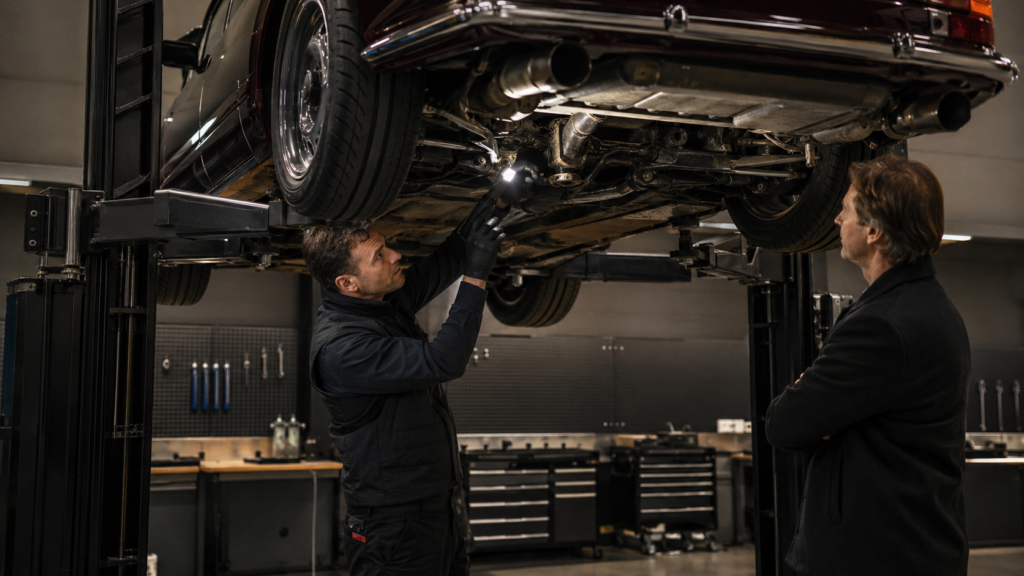
For a meaningful collector-car purchase, I would want an independent pre-purchase inspection—commonly called a PPI—from someone who knows that model or marque.
The Federal Trade Commission’s used-car buying guidance makes an important distinction: a vehicle-history report is not a substitute for an independent mechanical inspection. A history report may identify accidents, title events or flood information, but it typically will not tell you whether an engine has poor compression, a gearbox needs rebuilding or a suspension component is reaching the end of its life.
Collector-car specialists make the same point. Hagerty’s classic-car buying guidance recommends evaluating condition carefully and having a qualified professional inspect a car when appropriate.
A serious PPI may include, depending on the car:
- cold-start behavior;
- fluid leaks;
- compression or leak-down testing where appropriate;
- cooling-system condition;
- engine and transmission operation;
- brakes and suspension;
- tire age, not merely tread depth;
- electrical systems;
- corrosion and previous structural repair;
- undercarriage inspection on a lift;
- paint-depth measurements;
- signs of accident repair;
- VIN, chassis and engine-number verification where relevant;
- diagnostic scans on later vehicles;
- and deferred maintenance.
For some marques, a generic mechanic is not enough. A specialist who knows where a particular model cracks, leaks, corrodes, overheats or hides previous repair can be worth far more than the inspection fee.
If a seller refuses a reasonable independent inspection on a significant purchase, I would want an exceptionally good explanation before proceeding.
4. The paperwork is part of the car
One lesson collectors learn quickly is that the file sitting next to the car can matter almost as much as the car itself.
Good documentation can help establish how the vehicle was used, maintained, repaired, restored and cared for.
Depending on the vehicle, I would look for:
- service invoices;
- maintenance logs;
- prior ownership records;
- original window sticker or sales documentation;
- factory build information;
- books and manuals;
- spare keys;
- tool kit;
- restoration invoices and photographs;
- major component serial numbers;
- competition or show history;
- original parts removed during modifications;
- and documentation supporting any claim that materially affects value.
“Numbers matching,” “one owner,” “original paint,” “factory option,” “celebrity owned,” “never damaged” and “complete restoration” are not decorative phrases. If a claim affects the price, verify it.
5. Asking price is not market value
One of the biggest advantages today’s collector has is access to market information that previous generations of buyers did not have. Use it.
Hagerty Valuation Tools says its market analysis incorporates data from public auctions, private sales, dealer activity and asking prices, then considers factors such as equipment, provenance, mileage and condition when interpreting transactions.
That is a much better starting point than finding three optimistic dealer listings and calling the average “market value.”
2026 collector-market snapshot
The chart below uses current #3 “Good” condition values displayed in Hagerty Valuation Tools for several vehicles included in its 2026 market data. It is a snapshot—not a prediction—and it demonstrates how broad the modern enthusiast market has become.
Selected 2026 Hagerty #3 Good Condition Values
Source: Hagerty Valuation Tools. Values displayed when research was reviewed August 31, 2026. Market values change over time and individual vehicles can vary materially according to condition, specification, originality, provenance, mileage and other factors.
The lesson isn’t which one of these cars you should buy. It is that “collector car” describes a category of enthusiasm, not a uniform asset class.
Before making an offer, look at:
- recent sold transactions—not merely listings;
- condition;
- mileage where relevant;
- options and specification;
- transmission;
- originality;
- provenance;
- color combination;
- restoration quality;
- documentation;
- and the venue where comparable cars sold.
Two cars with the same year, make and model can legitimately be worth very different amounts.
6. Your budget is not the purchase price
The number on the bill of sale is only the first line of your ownership budget.
A more realistic first-year calculation looks like this:
| Cost | What to consider |
|---|---|
| Purchase price | Actual negotiated price plus applicable buyer fees |
| Taxes, title and registration | Varies by state and transaction |
| Transportation | Open vs. enclosed transport, distance and insurance |
| Immediate service | Fluids, belts, tires, battery, brakes or overdue maintenance |
| Deferred repairs | Items identified during inspection but not required before sale |
| Insurance | Collector coverage, value basis, usage and storage requirements |
| Storage | Home garage upgrades or professional storage |
| Detailing/preservation | Paint correction, interior preservation and appropriate protection |
| Ongoing maintenance reserve | Routine maintenance plus unpredictable age-related repairs |
I would rather see a first-time buyer purchase a slightly less expensive car and retain a healthy ownership reserve than stretch every available dollar to buy the car and then postpone the work it needs.
7. Research the people who will service the car before you buy it
This receives far less attention than it deserves.
Some collector cars are supported by enormous communities, mature specialist networks and readily available replacement parts. Others require hunting obsolete components across the world, rebuilding assemblies that are no longer produced or shipping the car significant distances to someone who truly understands it.
Before buying, answer:
- Who will service this car near me?
- Is there a recognized marque specialist?
- Are common maintenance parts available?
- Which parts are difficult or impossible to replace?
- Are there known failure points?
- Does the car require proprietary diagnostic equipment?
- What are the major scheduled services?
- Does the owner’s community have strong technical knowledge?
The best enthusiast communities are incredibly valuable. Owners who have lived with the model often know what buying guides miss.
8. Talk to the insurer before you buy the car
Collector-car insurance deserves attention before money changes hands, particularly if the vehicle is valuable, modified, unusually used or stored somewhere other than your residence.
One issue worth understanding is how the policy values the vehicle in a covered total loss.
As explained in Hagerty’s guide to agreed value, stated value and actual cash value coverage, these terms can lead to very different outcomes. In general, agreed-value coverage establishes an insured value with the carrier in advance, while actual-cash-value coverage is based on the vehicle’s value at the time of the loss. Stated-value policies can operate differently again.
Do not assume the terminology means exactly the same thing across every carrier or policy. Ask the insurer specifically:
- What happens in a covered total loss?
- What value is actually paid?
- Are there mileage or usage conditions?
- How must the vehicle be stored?
- Who may drive it?
- Are modifications covered?
- Are spare parts covered?
- Does coverage apply during transport?
- Is competitive or on-track use excluded?
Specialty collector insurers may also have eligibility requirements related to vehicle use and storage. Hagerty, for example, describes collector coverage designed around vehicles that are not used as everyday transportation on its collector-car insurance information page.
9. Trust the seller—but independently verify the VIN, title and history
A clean-looking car does not guarantee a clean history.
The U.S. Department of Justice’s National Motor Vehicle Title Information System (NMVTIS) exists in part to help protect consumers from fraud and unsafe vehicles. NMVTIS reports can provide information involving title-brand history, reported odometer readings, junk and salvage history and insurance total-loss reporting where that information is available.
The Department of Justice maintains a list of approved NMVTIS vehicle-history report providers that consumers can use when researching a prospective purchase.
Vehicle-history data is only one layer of due diligence. The FTC recommends combining history research with an independent mechanical inspection.
For supported vehicles, I would also run the VIN through the National Highway Traffic Safety Administration’s recall lookup to check for open safety recalls.
For older collector cars, VIN formats, electronic records and available history can differ considerably from modern vehicles. That makes physical documentation and marque expertise even more important.
Florida buyers: add one more check
Because Auto Vault Orlando serves collectors in Central Florida, there is another official resource worth knowing. The Florida Department of Highway Safety and Motor Vehicles provides a free Motor Vehicle Information Check that lets you search using a Florida title number or VIN.
If anything about a title, VIN or ownership chain looks unusual, resolve it before sending the money.
No amount of rarity makes a title problem fun.
10. Decide where the car will live before it arrives
Storage is one of the most underestimated parts of collector-car ownership—especially in Florida.
A collector car can spend hundreds of hours parked for every hour it spends being enjoyed. Where those parked hours happen matters.
Think about:
- heat;
- humidity;
- water and storm exposure;
- security;
- battery maintenance;
- pest control;
- dust;
- sun exposure;
- door clearance;
- tire care;
- insurance requirements;
- and whether the storage arrangement makes the car easy enough to use that you will actually enjoy it.
If you are planning to store a vehicle for more than occasional overnight parking, start with our classic-car storage guide.
Florida owners should also understand why environmental conditions matter. Our guide to climate-controlled storage for luxury and exotic cars explains some of the issues created by heat, humidity and long periods of inactivity.
If you’re deciding whether professional storage is necessary at all, see our comparison of professional collector-car storage versus a traditional home garage.
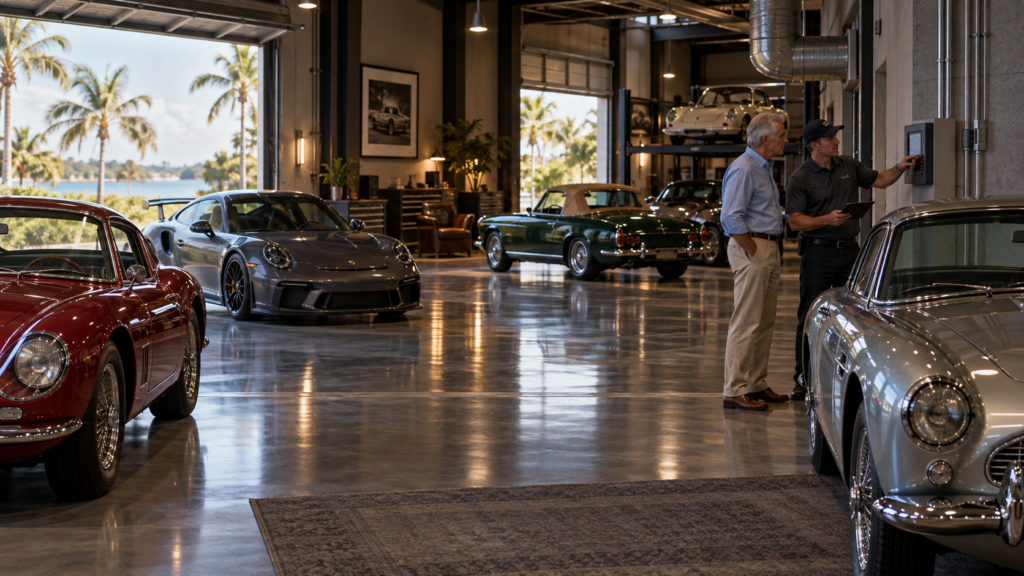
At Auto Vault Orlando, this issue is particularly close to us. The Vault provides a climate-controlled, 24/7-monitored environment designed around exotic, classic, collectible, high-performance and personally significant vehicles in Central Florida.
You can also see inside the Auto Vault Orlando facility before deciding whether professional vehicle storage makes sense for you.
But even if you never store a car with us, decide on the storage plan before buying the car. It belongs in the ownership calculation from day one.
11. Original is not always better—but understand what you are changing
Collector discussions can become almost religious when the word “original” enters the conversation.
The answer depends on the car.
For some vehicles, factory paint, numbers-matching drivetrains, original interiors and period-correct details can dramatically influence collectibility. For others, tasteful modifications are accepted—or even expected—within the enthusiast community.
The mistake is not modifying a collector car.
The mistake is spending money on modifications without understanding whether you are removing something difficult to replace or changing a characteristic that the next owner may value highly.
Whenever practical:
- keep significant original parts;
- document modifications;
- favor reversible changes;
- keep invoices;
- photograph work;
- and understand the market for both original and modified examples before cutting, drilling or discarding anything important.
12. A collector car is a terrible investment if you don’t like the car
Can collector cars appreciate? Absolutely.
Can they depreciate? Absolutely.
Can maintenance, insurance, transportation, storage, commissions, repairs and opportunity cost consume a meaningful portion of a nominal gain? Also yes.
Even collector-market valuation data shows that individual models move in different directions over time. Some rise sharply, some remain relatively flat and others decline.
That is why I prefer to treat potential appreciation as a benefit rather than the entire reason to own the car.
Buy intelligently. Understand the market. Protect the downside. Recognize rarity and historical significance. But do not turn the entire experience into a spreadsheet.
If the market stays flat for five years, would you still walk into the garage and be happy to see the car?
If the answer is yes, you are starting from the right place.
My first-collector-car scorecard
If I were helping someone evaluate a car today, these are the questions I would want answered before an offer became a wire transfer.
| Question | Green flag | Warning sign |
|---|---|---|
| Why this car? | Clear ownership goal | FOMO or expected appreciation only |
| Market value? | Supported by recent comparable sales | Based primarily on asking prices |
| Condition? | Independent specialist PPI | Seller description only |
| History? | Documentation supports claims | Important claims are verbal |
| Identity/title? | VIN/chassis/title agree | Inconsistencies or unexplained history |
| Maintenance? | Documented, current and understood | Long gaps or unknown major services |
| Parts/support? | Specialists and parts available | No nearby expertise or scarce critical components |
| Insurance? | Quote and coverage confirmed | “I’ll figure it out afterward” |
| Storage? | Secure environment arranged | No suitable space available |
| First-year budget? | Reserve remains after purchase | Purchase consumes entire budget |
| Emotional test? | You want the car even if prices stay flat | Primary goal is resale profit |
The documents I would want before closing
- Clear ownership and title documentation appropriate to the jurisdiction.
- VIN and chassis verification.
- Independent PPI report.
- Available service history.
- Vehicle-history and title-brand research.
- Documentation supporting important originality or provenance claims.
- Purchase agreement or bill of sale.
- Insurance confirmation effective when ownership transfers.
- Transportation arrangements if the car is not being driven home.
- All keys, books, tools, accessories, removable original parts and records included in the sale.
What I would do during the first 30 days of ownership
Once the car is yours, resist the urge to immediately modify everything.
- Create a baseline. Photograph the car thoroughly, scan records and organize the documentation.
- Address safety first. Tires, brakes, fluids, leaks and overdue critical maintenance take priority.
- Learn the car. Drive it enough to understand what is normal before changing it.
- Establish a trusted specialist. Do this before an emergency creates the introduction for you.
- Confirm insurance documentation. Make sure the insured value and intended usage accurately reflect the vehicle.
- Set up proper storage. Battery support, environment, security and access should become routine.
- Join the community. Owners’ groups, marque clubs, events and experienced enthusiasts can make ownership substantially better.
That final point is easy to underestimate.
Cars are why many of us enter this hobby. The people are often why we stay.
That philosophy is part of why we created Auto Vault Orlando as more than a place to park cars. It is a private automotive club and secure vehicle Vault built around people who understand that an exceptional car becomes even more enjoyable when there is a community around it.
If that sounds like your kind of environment, you can explore Auto Vault Orlando membership, look inside the Vault, or meet the team behind Auto Vault Orlando.
Frequently asked questions about buying your first collector car
What is the best first collector car to buy?
The best first collector car is usually one that you genuinely want, can afford to maintain, can insure appropriately, can store correctly and can have serviced without extraordinary difficulty. A well-supported Porsche, Corvette, Mustang, BMW, Mercedes, Japanese performance car or other enthusiast model may be easier to learn with than an extremely obscure vehicle, but the right answer depends on your goals, budget and interests.
How much should I spend on my first collector car?
Do not set your budget at the maximum amount you can spend on the purchase itself. Leave room for taxes and registration, transportation, insurance, immediate maintenance, deferred repairs and proper storage. The appropriate reserve depends heavily on the vehicle.
Should I get a PPI before buying a classic car?
Yes. An independent pre-purchase inspection by a mechanic or marque specialist familiar with the vehicle is one of the most important steps in collector-car due diligence. The Federal Trade Commission specifically warns that a vehicle-history report is not a substitute for an independent mechanical inspection.
Is low mileage always better on a collector car?
No. Mileage can influence value on some models, but extremely low mileage does not automatically mean excellent mechanical condition. Cars can deteriorate while sitting, and long periods without proper service create their own issues. Condition, history, maintenance, specification and usage should be considered alongside mileage.
Should I buy an original or restored collector car?
It depends on the model and your ownership goals. Highly original cars may command premiums in some markets, while a properly restored car can provide an excellent ownership experience. Evaluate restoration quality and documentation rather than assuming “restored” automatically means better.
Can a collector car be a good investment?
Some collector cars appreciate, but there is no guarantee. Transaction costs, repairs, maintenance, insurance and storage also affect the economics. A collector car should generally make sense to you as something you want to own even if its market value does not rise.
What paperwork matters when buying a collector car?
Important documentation can include the title, VIN or chassis information, service records, restoration records, factory documentation, books and manuals, ownership history, original parts and evidence supporting claims about provenance, originality or major options.
How do I check a collector car’s title history?
Start by comparing the physical VIN or chassis number with the ownership documents. U.S. buyers can also research title-brand and salvage information through the Department of Justice’s NMVTIS system. Florida buyers can perform an additional search through the state’s Motor Vehicle Information Check.
How do I check whether a collector car has an open recall?
For vehicles supported by the system, enter the VIN into the official NHTSA recall lookup. Keep in mind that older collector vehicles may predate the modern 17-character VIN system or have less complete electronic records.
Do collector cars need special insurance?
Many owners use specialty collector-car policies because valuation, usage and storage requirements can differ from standard daily-driver insurance. Understand agreed value, stated value, actual cash value, usage restrictions, storage requirements and exclusions before selecting coverage. Hagerty provides a useful explanation of collector-car valuation terminology, but always review your actual policy with your insurer or agent.
How should a collector car be stored in Florida?
Florida owners should consider heat, humidity, storms, security, battery maintenance, environmental exposure and periods of inactivity. Start with Auto Vault Orlando’s classic-car storage guide and our discussion of climate-controlled vehicle storage in Florida.
Is professional car storage better than a home garage?
Not necessarily for every owner. A secure, appropriately equipped home garage may work well for a car that is driven frequently. Professional storage becomes more attractive when an owner needs additional space, environmental control, enhanced security or a purpose-built collector-car environment. See our full comparison of professional luxury-car storage versus a traditional garage.
What is the biggest mistake first-time collector-car buyers make?
One of the biggest mistakes is allowing excitement about the model to replace due diligence on the individual car. The right model in poor condition, with uncertain history, weak documentation or no realistic ownership plan can still be the wrong purchase.
Authoritative resources for first-time collector-car buyers
These are resources I would keep bookmarked when researching a purchase:
- Hagerty Valuation Tools — collector-car market values, sales data and condition-based valuation information.
- Federal Trade Commission Used-Car Buying Guide — independent inspections, vehicle-history reports, warranties and consumer buying considerations.
- National Motor Vehicle Title Information System — federal title-brand, odometer, junk, salvage and total-loss information.
- NHTSA Recall Lookup — official federal search for open vehicle safety recalls.
- Florida Motor Vehicle Information Check — Florida title and VIN search.
- Collector-Car Insurance Value Guide — explanation of agreed value, stated value and actual cash value concepts.
How this article was created and researched
This guide combines my experience in the automotive enthusiast and performance-driving community with current research from authoritative consumer, government and collector-car sources.
External research for this article includes the Hagerty Valuation Tools, the Federal Trade Commission, the U.S. Department of Justice’s National Motor Vehicle Title Information System, the National Highway Traffic Safety Administration, the Florida Department of Highway Safety and Motor Vehicles and historical information from Chin Track Days.
The goal is to help enthusiasts ask better questions before buying. This article is educational and should not be considered mechanical, appraisal, insurance, legal, tax or investment advice. Vehicle values, regulations, insurance requirements and individual vehicle conditions change over time.
Auto Vault Orlando · Central Florida
Your first collector car deserves the right home.
If you already own an exotic, classic, collectible or high-performance vehicle—or the first one is finally on its way—see how Auto Vault Orlando combines climate-controlled vehicle storage with a private automotive club built around the people who love exceptional cars.