Automotive Events & Community · Auto Vault Orlando
By Vincent Howard
Managing Partner, Auto Vault Orlando · Co-Founder, Chin Motorsports / Chin Track Days
Research reviewed September 2026
The cars get people to a Cars & Coffee. They are not necessarily what makes people come back.
A memorable Cars & Coffee is part car show, part neighborhood gathering, part rolling automotive museum and part social club with no dress code. It creates enough structure to feel intentional without becoming so controlled that the spontaneity disappears.
That balance is harder to achieve than it looks.
After more than 25 years around performance driving, track events and enthusiast communities—including helping establish Chin Motorsports in 1999, now Chin Track Days—I’ve seen automotive gatherings that become fixtures on people’s calendars and others that technically have great cars but never develop a real community.
The difference usually isn’t horsepower.
It’s culture.
Quick answer: What makes a great Cars & Coffee?
A great Cars & Coffee combines interesting and diverse vehicles, welcoming people, consistent scheduling, good traffic flow, a safe atmosphere, real coffee and food, enough space to walk and talk, and organizers who protect the culture without over-controlling it.
The best events make the owner of a million-dollar exotic, the teenager photographing it and the person arriving in a lovingly restored $8,000 project car all feel like they belong in the same conversation.
The cars create attention. The community creates longevity.
What we’ll cover
- The right mix of cars
- Community before status
- Consistency and predictability
- A venue that actually works
- Safety without killing the atmosphere
- Coffee, food and hospitality
- A reason to wonder what will show up
- Welcoming the next generation
- Making conversation easier
- Photography and social media
- Sponsors without turning it into a trade show
- The departure matters too
- Cars & Coffee in Orlando and Central Florida
- The Auto Vault Cars & Coffee Quality Index
- Frequently asked questions
Why Cars & Coffee works in the first place
Cars & Coffee is one of the simplest formats in automotive culture.
No concours judging is required. No racetrack is necessary. Nobody needs a tuxedo. Owners arrive, park, grab coffee and talk about cars for a few hours.
That simplicity is a strength.
Current Hagerty enthusiast research reports that roughly two-thirds of enthusiasts attended an automotive event during the prior two years and 90% planned to attend one in the coming years. Hagerty specifically identifies laid-back Cars & Coffee gatherings as increasingly popular enthusiast events.
You can see the underlying data in Hagerty’s collector-car market research.
Automotive Event Participation
Source: Hagerty collector-market research available in 2026. The data reflects Hagerty’s enthusiast research population and is not a census of every U.S. motorist.
That’s an important distinction.
Cars & Coffee isn’t succeeding because people suddenly became interested in parking lots.
It succeeds because automobiles are inherently social objects for enthusiasts.
1. Start with variety—not just value
A row of twelve nearly identical supercars can be impressive.
It isn’t always interesting for three hours.
Variety creates conversation.
A great Cars & Coffee might place:
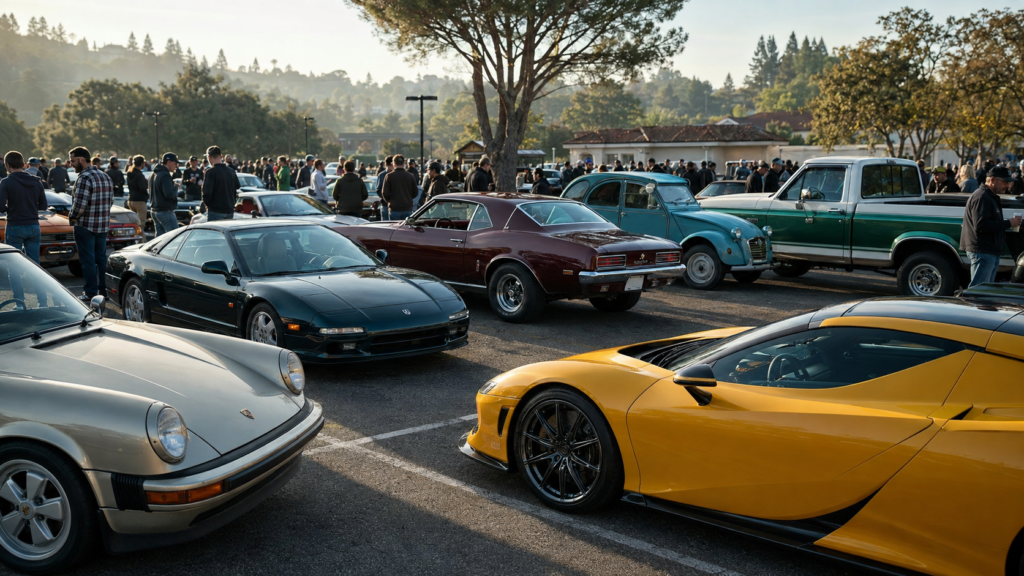
- a Ferrari 458 near a first-generation Honda NSX;
- a Porsche 356 near a modern GT3;
- a beautifully preserved pickup beside a McLaren;
- a 1980s BMW near a current M car;
- a Japanese kei car beside a Detroit muscle car;
- a concours restoration near an owner-built project;
- and a vehicle nobody can immediately identify somewhere in between.
That is more compelling than sorting every car purely by its market value.
Successful Central Florida events already demonstrate this principle.
Cars and Coffee Winter Garden says its monthly gatherings feature more than 250 vehicles and explicitly welcomes exotics, American muscle, JDM, European cars, EVs, motorcycles and trucks.
Orlando Cars & Coffee Sanford, whose roots go back to 2013, similarly describes a mix ranging from supercars and modern exotics to imports, domestics and one-off builds.
That diversity is a feature—not a compromise.
What enthusiasts actually value about their cars
Hagerty’s current collector research provides another clue about event design.
The top reported motivations for owning collector vehicles include:
Why Enthusiasts Own Collector Vehicles
Source: Hagerty collector-market research. Respondents could have multiple motivations.
Think about what that means for Cars & Coffee.
People aren’t interested only in financial value or rarity.
They care about driving, design and memories.
A great event gives all three room to exist.
2. Build community before exclusivity
There is nothing wrong with a curated exotic event.
There is nothing wrong with a Porsche-only gathering either.
But a general Cars & Coffee works best when enthusiasts understand what qualifies them to participate.
Ideally, the answer is:
You care about cars.
The teenager with a camera may become tomorrow’s collector.
The person arriving in a stock Miata may know more about chassis setup than someone who owns five exotics.
The retiree standing beside a 1967 Corvette may have owned it longer than the person asking questions has been alive.
Automotive culture becomes more interesting when those people interact.
This is also one reason we wrote about why enthusiasts join private car clubs. Whether the gathering is free and public or membership-based, the recurring value often becomes the same thing: people who understand the interest.
The best automotive event isn’t the one where everyone owns the same kind of car. It’s the one where everyone has something to talk about.
3. Be boringly consistent about when and where it happens
The event itself should be interesting.
The logistics should not be.
“First Sunday, 9 to noon” is better than requiring someone to hunt through social media every month to determine whether an event exists.
Consistency builds habit.
Orlando Cars & Coffee Sanford has used a recurring monthly format for years. Cars and Coffee Winter Garden similarly publishes a recurring fourth-Saturday schedule.
The broader Cars and Coffee Events organizer guidance emphasizes accurate recurring dates, locations, time zones and event details because predictable information is critical to helping attendees actually find an event.
If possible, organizers should publish:
- the recurrence pattern;
- start and end times;
- exact address;
- show-car entrance;
- spectator entrance;
- parking instructions;
- rain policy;
- vehicle eligibility;
- basic event rules;
- food/coffee availability;
- and accessibility information.
The fewer unanswered logistical questions an attendee has, the easier it is to simply show up.
4. Choose the venue for circulation, not just capacity
A parking lot can technically hold 300 cars and still be a terrible automotive event venue.
The better question is whether 300 cars and several hundred pedestrians can move through it comfortably.
Look for:
- clear vehicle ingress;
- a different flow for spectators where possible;
- wide pedestrian aisles;
- overflow capacity;
- visible accessible parking;
- restrooms;
- shade or indoor refuge;
- food-service access;
- emergency access;
- minimal conflict with neighboring businesses;
- reasonable noise expectations;
- and an exit that does not dump every performance car into the same bottleneck.
The venue also affects photographs and memory.
A beautiful downtown street, historic district, automotive facility or interesting architectural backdrop changes the experience without changing a single vehicle.
That is part of why professionally managed automotive venues can elevate the format. Cars En Coffee at The Motor Enclave in Tampa combines an open vehicle mix with a purpose-built motorsports venue, food, coffee and professional event operations.
5. Protect the event from the five seconds that can ruin it
Anyone who has spent enough time around car meets knows the problem.
Nine hundred people can behave responsibly.
One person leaving sideways can become the only part of the event anyone remembers.
Organizers have to protect the event from that.
The long-running Orlando Cars & Coffee Sanford event rules explicitly prohibit burnouts, speeding and street racing and ask drivers to be mindful of children and animals.
Those aren’t anti-car rules.
They are pro-event rules.
A venue owner, neighboring business or local municipality doesn’t care that 99.9% of attendees behaved perfectly if the remaining fraction creates a serious incident.
At a minimum, I like:
- clear entrance and exit speeds;
- visible staff near high-traffic areas;
- defined pedestrian zones;
- no burnouts;
- no street racing;
- no aggressive exits;
- reasonable revving expectations;
- and rules communicated before the problem occurs.
6. Don’t forget the coffee part of Cars & Coffee
This sounds obvious.
It apparently isn’t.
Good coffee does more than satisfy the name.
It gives people something to do with their hands while they talk. Food keeps them at the event longer. Seating creates places for conversations that aren’t happening beside a hood.
A strong hospitality setup might include:
- quality coffee;
- water;
- breakfast items;
- a local coffee partner;
- several service points for larger events;
- trash stations;
- some seating;
- and shade.
The goal isn’t to turn Cars & Coffee into brunch.
The goal is to prevent the hospitality from becoming the weakest part of the morning.
7. Leave enough randomness that people wonder what will show up
Cars & Coffee loses something when every vehicle is pre-selected and every parking space is assigned.
Part of the appeal is uncertainty.
You walk in and see something you weren’t expecting.
Maybe it’s a Carrera GT.
Maybe it’s a Citroën DS.
Maybe it’s a kei truck.
Maybe it’s an immaculate 1980s Toyota that immediately transports someone back to high school.
Orlando Cars & Coffee Sanford actually highlights this phenomenon in its event description: even the organizers don’t always know what will arrive each month.
That’s a feature worth protecting.
You can reserve areas for featured marques, clubs or special displays without programming every square foot of asphalt.
8. Give people something to discover besides parked cars
The simplest Cars & Coffee needs very little programming.
But one or two well-chosen additions can make the morning feel fresh without turning it into a festival.
Examples include:
- a featured car with an interesting story;
- a restoration reveal;
- a short owner interview;
- a marque anniversary;
- a local race car;
- a historic competition vehicle;
- a technical demonstration;
- a charity component;
- a shop or collection tour;
- a simulator challenge;
- or a coordinated club feature.
Cars and Coffee Winter Garden, for example, incorporates charitable events during the year, while other contemporary gatherings layer in voting, food, photography or automotive experiences.
The key is restraint.
If the programming makes it difficult to simply walk around and talk about cars, you’ve probably added too much.
9. Make younger enthusiasts feel welcome
One of the best things about Cars & Coffee is that it can be a child’s first close encounter with a genuinely special car.
That matters.
Tomorrow’s collector might be the ten-year-old asking the owner of an air-cooled Porsche why the engine is in the back.
A welcoming event allows curiosity without treating every car like a museum object.
That does not mean children should climb into someone’s Ferrari uninvited.
It means owners and organizers can help create a culture where questions are welcomed, parents understand the boundaries and younger enthusiasts aren’t treated as if they wandered into the wrong hobby.
The Motor Enclave describes its Cars En Coffee event as a family-friendly community gathering, and Orlando Cars & Coffee’s published rules specifically account for children and animals in the pedestrian environment.
A hobby that doesn’t create new enthusiasts eventually becomes a museum.
10. The organizers should optimize for conversation, not just car count
“500 cars attended” sounds impressive.
It does not necessarily mean 500 cars could be appreciated.
If cars are jammed bumper-to-bumper and attendees are being pushed through narrow aisles, the event has maximized inventory rather than experience.
I would rather have:
250 cars people can actually see than 500 cars nobody can comfortably walk around.
Give owners enough room to stand next to their cars.
Let people photograph them without blocking an entire aisle.
Create small natural gathering points.
Position coffee where people naturally pass through rather than in a remote corner.
The social architecture matters almost as much as the physical architecture.
11. Create an event people naturally want to photograph
Social media should document a good Cars & Coffee.
It should not be required to manufacture the impression that the event was good.
A few basics help enormously:
- good morning light;
- clean backgrounds;
- enough room between feature vehicles;
- one or two intentional photo areas;
- consistent event naming;
- a simple hashtag;
- professional photography when the budget permits;
- and reposting attendees’ best images with credit.
People already want to photograph interesting vehicles.
Make it easy for them.
And don’t publish only the most expensive cars.
Photos of owners talking, parents showing children an engine, unusual details and mixed generations of enthusiasts often communicate the event better than another isolated supercar photograph.
12. Sponsors should improve the morning—not invade it
Sponsors can be extremely useful.
They can help cover:
- venue cost;
- coffee;
- security;
- staffing;
- photography;
- insurance;
- entertainment;
- charitable donations;
- and special vehicles or experiences.
But the minute every conversation feels like lead generation, the culture changes.
A good sponsor should have some legitimate connection to the audience or improve the experience.
A detailer demonstrating paint correction can add value.
A specialist bringing an unusual engine can add value.
A local coffee shop obviously adds value.
A table where somebody aggressively tries to capture every attendee’s phone number probably does not.
Community first.
Commercial opportunity second.
13. The event isn’t over until the last car leaves
Departure is often the most dangerous part of a car gathering and the moment most likely to annoy neighboring businesses and residents.
People line the exit with phones.
Drivers feel watched.
Someone inevitably wants to make the departure memorable.
Organizers should make the expectation exactly the opposite.
The best exit is the boring one.
No crowd creating a burnout corridor.
No organizer encouraging displays on public roads.
No ambiguity about speed.
If people want to experience performance driving, there are appropriate environments for it.
That is a distinction I have cared about throughout my years around high-performance driver education: enthusiasm and responsible performance driving are completely compatible.
14. A great Cars & Coffee should feel different at 8:05 and 10:05
Events have rhythm.
The early crowd often consists of serious owners and photographers.
Then the field fills.
Conversation clusters form.
Families arrive.
Some cars leave and unexpected ones replace them.
By late morning, people begin breaking into smaller groups for breakfast, drives or whatever comes next.
That’s healthy.
An event does not need constant announcements or entertainment to stay interesting.
Sometimes the organizer’s best decision is to create the conditions and then get out of the way.
What makes a great Cars & Coffee in Orlando and Central Florida?
Central Florida has an unusually useful environment for automotive gatherings: a large enthusiast population, a wide mix of collector and performance vehicles and the ability to hold events through much of the year.
But Florida changes the logistics.
Morning timing matters.
According to National Weather Service climate normals for Orlando, typical July highs are around 92°F, with substantial summer rainfall. That makes early starts, shade, water and a realistic weather plan more than comfort details. See the National Weather Service Orlando climate normals.
For a Central Florida event, I would prioritize:
- an early start in warmer months;
- shade or an indoor retreat;
- plenty of water;
- weather monitoring;
- drainage and rain contingencies;
- simple arrival routes;
- parking that doesn’t interfere with neighboring businesses;
- family-friendly pedestrian space;
- and enough variety to reflect the breadth of the local automotive community.
What current Central Florida events teach us
| Event | What stands out | Lesson |
|---|---|---|
| Orlando Cars & Coffee Sanford | Established in 2013, recurring monthly format, hundreds of cars, all makes/models | Consistency and variety build longevity |
| Cars & Coffee Winter Garden | 250+ vehicles across exotics, muscle, JDM, Euro, EVs, trucks and motorcycles | Broad inclusion keeps the field interesting |
| Cars En Coffee at The Motor Enclave | Purpose-built automotive venue, open participation, food, professional operations | The venue can elevate the entire experience |
Those events use different models.
That’s the point.
There is no single perfect Cars & Coffee formula.
But the strongest gatherings repeatedly solve the same problems: interesting cars, easy participation, safe logistics and real community.
The Auto Vault Cars & Coffee Quality Index
If I were evaluating an event—not scientifically, but from an enthusiast-experience perspective—this is how I would weight it.
Important: This is an original Auto Vault Orlando editorial framework, not survey data or an industry standard.
| Factor | Weight | What “great” looks like |
|---|---|---|
| Community & culture | 20% | Welcoming owners and spectators; conversations happen naturally |
| Vehicle variety | 15% | Interesting mix across eras, marques, values and styles |
| Safety & traffic flow | 15% | Controlled arrivals/departures and clear pedestrian space |
| Consistency | 10% | Predictable schedule and reliable communication |
| Venue | 10% | Good circulation, capacity, backdrop and basic amenities |
| Hospitality | 10% | Good coffee, food, water, shade and restrooms |
| Surprise / discovery | 5% | Something unexpected enough to reward repeat attendance |
| Family / newcomer welcome | 5% | Younger and new enthusiasts feel comfortable participating |
| Photography / content | 5% | Environment makes sharing the event natural |
| Departure experience | 5% | Orderly exit without creating risk or community complaints |
| Total | 100% |
How I’d interpret the score
| 90–100 | An event enthusiasts plan their month around. |
| 80–89 | Very strong event with a recognizable culture. |
| 70–79 | Good gathering with identifiable opportunities to improve. |
| 60–69 | Cars are carrying more of the experience than the event itself. |
| Below 60 | Likely functioning more as a parking-lot meet than a sustainable community event. |
A simple checklist for Cars & Coffee organizers
Before publishing the date, I would want clear answers to these questions:
- Who is the event for?
- Are all cars welcome or is it curated?
- How many show cars can the venue comfortably support?
- Where do spectators park?
- How will cars enter and leave?
- Where will pedestrians walk?
- What are the behavior and safety rules?
- Who is enforcing them?
- Where does the coffee come from?
- Are restrooms available?
- Is there water and shade?
- What happens if it rains?
- How will attendees know the next date?
- What does the event offer that makes somebody want to return?
- Would neighboring businesses want you back next month?
That last question may be the most important operational question on the list.
What should you bring to Cars & Coffee as an attendee?
Not much.
That’s part of the appeal.
Depending on the event:
- arrive with a clean car if you’re displaying it;
- bring water in warm weather;
- respect reserved and accessible spaces;
- don’t touch someone else’s vehicle without permission;
- ask owners questions;
- supervise children around vehicles;
- keep pets under control where permitted;
- follow organizer instructions;
- and leave responsibly.
You do not need an exotic car.
You don’t necessarily need a car at all.
Curiosity is enough to start.
Cars & Coffee can also make you want to buy something
There is one occupational hazard of attending enough automotive events.
You see cars you weren’t shopping for.
You hear an engine you had forgotten about.
An owner tells you what the car is actually like to live with.
Then you’re browsing listings before lunch.
That can be one of the joys of the hobby, but enthusiasm and due diligence should remain separate steps. If Cars & Coffee introduces you to your next collector vehicle, read our guide on what I wish I knew before buying my first collector car before turning a Sunday-morning discovery into a wire transfer.
Where a private automotive club fits
Cars & Coffee and a private car club solve different problems.
Cars & Coffee is open, spontaneous and often free.
A private club creates repeated access to a smaller community, permanent amenities and events between the large public gatherings.
They can complement each other.
We’ve explored that distinction more deeply in Why Enthusiasts Join Private Car Clubs.
At Auto Vault Orlando, the idea is not to replace the Central Florida automotive community. It’s to give enthusiasts another place inside it—a private home base with the Vault, lounge, racing simulators and member experiences.
You can see inside Auto Vault Orlando or review the current Auto Vault membership options.
Frequently asked questions about Cars & Coffee
What is Cars & Coffee?
Cars & Coffee is an informal automotive gathering, typically held during the morning, where owners display interesting vehicles and enthusiasts meet, drink coffee and talk about cars. Events range from small local gatherings to large recurring shows with hundreds of vehicles.
What makes a good Cars & Coffee event?
A good Cars & Coffee combines an interesting mix of vehicles, welcoming people, simple logistics, good coffee, adequate space, consistent scheduling and clear safety expectations. Strong events create community rather than simply accumulating cars.
Do you need a special car to attend Cars & Coffee?
Usually not. Many events are open to spectators regardless of what they drive. Vehicle-display rules differ by organizer, so check the event’s published requirements before assuming your car can enter the show area.
What cars should be allowed at Cars & Coffee?
That depends on the event’s identity. Some gatherings welcome virtually everything, while others focus on exotics, classics, European cars, JDM vehicles, a particular marque or another theme. For a broad community Cars & Coffee, diversity across eras, styles and price points often makes the event more interesting.
How long does Cars & Coffee usually last?
Many Cars & Coffee events run approximately two to four hours in the morning. Central Florida examples commonly use morning windows such as 8:00–10:30 a.m. or 9:00 a.m.–noon.
What time should I arrive at Cars & Coffee?
If you are displaying a vehicle, arrive within the organizer’s designated show-car arrival window. Spectators who want the quietest photography conditions and strongest vehicle selection often benefit from arriving near the beginning of the event.
Is Cars & Coffee family friendly?
Many events are explicitly designed to be family friendly. Parents should still supervise children closely because vehicles may be arriving, moving and departing throughout the morning. Always follow the organizer’s pedestrian and safety rules.
Can I bring my dog to Cars & Coffee?
Some events allow leashed dogs while others do not. Check the organizer’s rules first, and remember that loud exhausts, crowds and moving vehicles may not be comfortable for every animal.
Why are burnouts banned at Cars & Coffee?
Burnouts and aggressive departures create unnecessary risk for pedestrians, drivers, property owners and the event itself. A few seconds of irresponsible behavior can jeopardize a venue’s willingness to host future gatherings.
How many cars should a Cars & Coffee have?
There is no ideal number. A well-organized 75-car gathering can provide a better experience than a chaotic 500-car event. Capacity should be determined by safe vehicle circulation, pedestrian space, parking and the type of community the organizer wants to build.
How do I start a Cars & Coffee?
Start with a suitable venue and its written permission, then address insurance and local requirements, traffic flow, parking capacity, pedestrian safety, event rules, coffee/food, recurring dates, weather policy and promotion. Build attendance gradually rather than inviting more vehicles than the venue can safely handle.
How often should a Cars & Coffee happen?
Monthly is a common model because it creates habit without exhausting attendees or organizers. The best cadence is one the organization and venue can execute consistently.
Should Cars & Coffee charge admission?
It can, but many successful events remain free. Charges may make sense when a venue or experience involves significant operating costs. If admission is required, attendees should clearly understand what additional value the event provides.
Are Cars & Coffee events only about exotic cars?
No. Some feature exotics heavily, but many successful events mix classics, muscle cars, European cars, JDM builds, EVs, trucks, motorcycles, custom vehicles and unusual everyday cars. The passion behind the vehicle can matter more than its price.
Where can I find Cars & Coffee events in Orlando?
Central Florida has several recurring automotive gatherings. Examples include Orlando Cars & Coffee events in the greater Orlando/Sanford area and Cars and Coffee Winter Garden. Because schedules and venues change, confirm current details directly with the organizer before traveling.
How this article was researched
This guide combines my experience across more than 25 years in automotive enthusiast and performance-driving communities with current research on collector-car participation, established Cars & Coffee events and Central Florida automotive gatherings.
Sources reviewed include Hagerty’s collector-market research, Orlando Cars & Coffee Sanford, Cars and Coffee Winter Garden, The Motor Enclave’s Cars En Coffee, the Cars and Coffee Events organizer directory and National Weather Service climate data for Orlando.
The Auto Vault Cars & Coffee Quality Index in this article is an original editorial framework based on event experience and research. It is not presented as scientific survey data or an industry certification.
Auto Vault Orlando · Central Florida
The cars are the reason to show up. The people are the reason to stay.
Auto Vault Orlando was created for enthusiasts who want more of the community that makes automotive events worth attending.
Tour the climate-controlled Vault, members lounge, racing simulators and club spaces—and meet some of the people building the next chapter of Central Florida car culture.